Showing posts with label 2009-10 Valparaiso Poetry Review. Show all posts

Apr 8, 2010

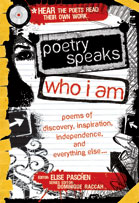
Poetry Speaks Who I Am by Elise Paschen

Elise Paschen's Poetry Speaks Who I Am combines written verse with audio recitation of poetry by the poets themselves on CDs spark young readers' love of poetry and verse.  Readers between the ages of 11 and 14 will find poems in this volume that speak to their struggles with love, family, growing into adulthood, and making friends.

"[Paschen says,] For me this poetry is life altering.  It's gritty.  It's difficult.  And it hurts in all the ways that growing hurts.  It's meant to be visceral and immediate.  It's meant to be experienced."  (Page XI)

Gritty and real are the best terms to describe the struggles within these lines of verse, from being the only white kid in school to being a Black person at a time when political correctness suggests you are African-America.  But more than that, there are poems about bra shopping -- the stepping stones of becoming a woman -- and the realization that the world is not perfect and that wars do exist.
Bra Shopping by Parneshia Jones  (Page 16)

Mama and I enter into no man's, and I mean no man in sight, land
of frilly lace, night gowns, grandma panties, and support everything.

A wall covered with hundreds of white bras, some with lace, ribbons,
and frills like party favors, as if bras are a cause for celebration.

Some have these dainty ditsy bows in the middle.
That's a nice accent don't you think? Mama says.  Isn't that cute?
Like a dumb bow in the middle of the bra will take away some of the
attention from two looking, bulging tissues.
Full of wit and sarcasm, this poem illustrates the angst and embarrassment of the narrator as she shops for bras with her mother under the watchful eye of the sales clerk. A number of poems illustrate these feelings of awkwardness and tenderness between friends and parents.

The audio CD that comes with the book is stunning as each poem is read with emphasis and care either by the poet themselves or a contemporary counterpart.  In some cases, the poems are accompanied by ambient noise and/or nature sounds.  Some poems will garner young readers' attentions more than others, but overall the CD works.
Used Book Shop by X.J. Kennedy (Page 108)

Stashed in attics,
stuck in cellars,
forgotten books
once big best-sellers

now hopefully sit
where folks, like cows
in grassy meadows,
stand and browse.

In a yellowed old history
of Jesse James
two earlier owners
had scrawled their names.

I even found
a book my dad
when he was in high school
had once had,

and a book I found --
this is really odd --
was twice as much fun
as my new iPod.

I always get hooked
in this dusty shop.
Like eating popcorn,
it's hard to stop.
Poetry Speaks Who I Am is a wonderful collection of classic and contemporary poems from the likes of Langston Hughes and Lucille Clifton to the contemporary works of Billy Collins and Molly Peacock.  Each poem will reach out to young adolescents in new and exciting ways, having them nod their heads in agreement as emotions, situations, and dilemmas are unleashed in verse.  Moreover, the poems selected in this volume will not have readers scratching their heads, wondering what it all means.  These poems are straight forward and get to the heart of the adolescent matter.

FTC Disclosure: Thanks to Sourcebooks for sending me a free copy of Poetry Speaks Who I Am for review.  Clicking on title and image links will lead you to my Amazon Affiliate page; No purchase necessary, though appreciated.

© 2010, Serena Agusto-Cox of Savvy Verse & Wit. All Rights Reserved. If you're reading this on a site other than Savvy Verse & Wit or Serena's Feed, be aware that this post has been stolen and is used without permission.

Mar 1, 2010

Sonnets for Sinners by John Wareham


John Wareham's Sonnets for Sinners is a book of poems I would recommend to those who enjoy reading sonnets, who love poetry, and those who are just starting to read poetry.  Wareham includes the classic sonnets of William Shakespeare and William Yeats, but he also crafts new sonnets from the words (available in the public domain) of famous figures, like Tiger Woods (click to read the poem Wareham created from Woods' words), Elizabeth and John Edwards, and Princess Diana.
What's most unique about this volume is the insight provided by Wareham.  He analyzes each poem, offers up lines that illustrate his examinations, and even poses questions that illicit laughter.

Discussing Shakespeare's Sonnet 129:  "To begin with, says the poet, sinners bypass rationality -- past reason hunted -- then, the moment the lusty act is completed they unreasonably despise themselves -- past reason hated -- for succumbing to a swallowed bait on purpose laid to make the taker mad.  The devil made me do it!"  (Page 11)

Sonnets for Sinners is broken down, categorizing sonnets into attractions, fevers, lamentations, farewells, endings, and epiphanies.  For anyone interested in reading more poetry, particularly classic sonnets and classic poets, readers would enjoy the commentary from Wareham.  It is not only informative, but witty.   

Kind Cuts by Chandler Haste (page 66)

"I don't want to hurt or abandon you
-- so what to do?" you ask.  Well maybe first
drop me into a pot of boiling glue
then have a witch doctor apply a curse.
Or when that fails and I rise in pursuit
of you, have a firebug set me aflame.
Or cut out my tongue and render me mute
then poke out my eyes and publish my shame.
Or, here's aptly felicitious fate
for this hopelessly addicted lover:
Bobbitting!  -- that could be the kindest bite
to slice me out from under your thumb of.
Off the top of my head that's my advice,
Bow to it gently, and in love, rejoice.

Despite the mix of contemporary and classic sonnets, I think there is enough in here to count for the contemporary poetry challenge, and this makes book #13.
This is my 1st book for the Clover Bee & Reverie Poetry Challenge.
This is my 12th new-to-me author for the 2010 New Authors Challenge.


FTC Disclosure:  I received a free copy of Sonnets for Sinners by John Wareham from publicist Sara Hausman at Meryl L. Moss Media Relations, Inc.  Clicking on title links or images will bring you to my Amazon Affiliate page; No purchase necessary.

Jan 26, 2010

Zombie Haiku by Ryan Mecum


Ryan Mecum's Zombie Haiku is another fun volume of loose-form haiku, like his recent publication Vampire Haiku (click for my review).  In the initial pages, readers learn that the journal is that of Chris Lynch, and the initial haiku spotlight the beauty of nature coupled with Polaroid images and are interspersed with comments from Lynch about his impending death and transformation.

The bird flew away
with more than just my bread crumbs.
He took my sorrow.  (Page 2)

Readers see first hand the spread of the zombies throughout the city and how they stagger after their latest victims.  Finally, Lynch is attacked himself, bleeding to death from a hole in his neck, before turning into the beings he sees taking over the human race.  Struggling with his transformation, he writes haiku about his love for his mother, and the strength he feels even as he withers and becomes a cannibal.

My lungs slow and stop
and I can't find my heartbeat
but I'm still hungry.  (Page 30)

With his jaw snapped off
he can't bite into people,
which means more for me.  (Page 66)

Readers may find that some haiku are not as well formed as others, but that may be because zombies have a mostly one-track mind -- brains or eating brains.  Overall, Zombie Haiku is not as engaging as Vampire Haiku was, though in small doses the haiku can be amusing. 


I'm counting this as my 12th book for the poetry reading challenge.


FTC Disclosure:  I purchased my copy of Zombie Haiku by Ryan Mecum.  Clicking on title links or images will bring you to my Amazon Affiliate page; No purchase necessary.

Dec 31, 2009

Vampire Haiku by Ryan Mecum


Ryan Mecum's Vampire Haiku mixes humor and poetry in diary form for vampire William Butten, who was turned in 1620.  He falls in love with a beautiful woman on the Mayflower named Katherine, who turned him into a vampire.  Soon he's parted from his love to roam America on his own and make his own friends.  There are tales of some well known historic figures from Davy Crockett to Amelia Earhart and famous events in history like the Civil War and Woodstock.

Readers may initialy be attracted to the cover haiku, which also appears on page 37:

"You know that your drink
is down to the last few sips
once the toes curl up."

Butten has a twisted sense of humor, but readers will enjoy is little anecdotes about becoming a vampire and bumbling around learning how to feed, etc.  Mecum uses his linguistic and historic knowledge to create fun and witty haiku.  Although they are not precisely haiku in the traditional sense, they mostly adhere to the form's syllable count.  It is fun to see Butten reveal insider knowledge about the deaths of Davy Crockett and other major historical figures.  In some cases, the poems will have readers cringing in disgust.

"Discarded band-aids
are rare unexpected treats.
My version of gum."  (page 113)

There are even moments in the book where the vampire makes fun of the modern vampire crazes from the goth kids to the latest vampire movies.  One of the best haiku in the book is about the Twilight movie:

"Those were not vampires.
If sunlight makes you sparkle,
you're a unicorn."  (page 117)

Will Butten ever find his true love, Katherine, or will he stop searching for her and settle down? Overall, those interested in humor and vampires will find Vampire Haiku to be a treat.  I'm looking forward to reading Ryan Mecum's Zombie Haiku next.


I'm counting this as my 11th book for the poetry reading challenge.

By the way, I unintentionally read 100 books this year and reviewed all 100!  This is quite an accomplishment for me, since I'm a slower reader than most.  Yipee!


FTC Disclosure:  I purchased my copy of Vampire Haiku by Ryan Mecum.  Clicking on title links or images will bring you to my Amazon Affiliate page; No purchase necessary.

Dec 29, 2009

Words That Burn Within Me by Hilda Stern Cohen


Hilda Stern Cohen's Words That Burn Within Me is a collection of photographs, essays, stories, snippets of interviews, and poems detailing Cohen's experiences during WWII and the Holocaust as a German resident.  (Please check out a recent reading from the book at The Writer's Center).  Cohen's husband, whom she married in Baltimore, Md., in 1948 following her release, discovered her notebooks after her death and set about his journey to have his wife's writing translated from German and published.  In some cases, the poems are included both in English and in German.

"Our physiognomies were ageless.  There were wild, unfocused eyes, silent, indrawn lips, and haggardness around the cheek and neck . . . only defined and exaggerated by hunger." (Page 49)

This harrowing story follows Hilda through her early years in Nieder-Ohmen, Germany, and her transfer to schools in Frankfurt as the Nazis gained power.  From Frankfurt, she is transported with her family and young beau Horst to Lodz, Poland, only to face devastating circumstances, the loss of Horst, and more and be transported to Auschwitz.  In a series of essays and interviews, Hilda talks about happier times in her village and with her sister, the trials of childhood and being bullied, but soon the reality of politics sets in and her family is forced to leave their ancestral home.

Forced Labor (Page 54)

My numbed brow drops on the machine,
I fold my captive, tired hands.

A dangling yellow bulb sheds smoky light,
Dusk falls, the day grows pale.

The harried working hours are almost done,
The evening mist is waiting to embrace us.

What binds us in our common chains
Will only hold us while we work --
Night will find each of us in separate gloom.

Cohen's writing is sparse but detailed in its observations of those around her in the ghetto and the concentration camps.  Her keen eye examines the impact of starvation on her fellow neighbors and on her family members, and it also sheds light on how well her family and herself cope with their situation.  She eventually teaches herself Yiddish after joining a literary group because she only speaks and writes German, which is not what the majority of the Lodz Ghetto understands.  Readers, however, will note a sense of detachment in her writing, almost as if she is reporting the events as she observed them rather than as she felt them.  On the other hand, they will hear the anger and disappointment in her voice, especially when she speaks of the last words her father utters about her mother upon her death.

"There was a strange role reversal that took place psychologically, as it did also later in the camps.  Adults who had lived a life from which they had gained certain expectations were suddenly confronted with an abyss.  There were no signs, no gateposts, none of the usual milestones that one could follow.  Everything had fallen away."  (Page 33)

Words That Burn Within Me is well assembled mixture of interviews with Hilda Stern Cohen's essays, stories and poems.  While the collection does illustrate one Jewish woman's journey during WWII and the Holocaust, it stands as a testament -- a record -- of how inexcusably these humans were treated and how their debasement impacted their lives, their relationships, their faith, and their souls.  Through well tuned description and controlled emotions, Cohen takes the time to record everything she saw during the war and the Holocaust to ensure that it becomes a warning to others.  A powerful collection and a must read for anyone learning about this time period and the horrors that should never have happened.

This is my 10th book for the WWII Reading Challenge at War Through the Generations!


I'm not sure if this will qualify for the Poetry Review Challenge, but if it does, this will be book #10.


 FTC Disclosure:  I purchased my copy of Words That Burn Within Me from The Writer's Center following a reading by Hilda Stern Cohen's husband and her interviewer Gail Rosen.  Clicking on image and title links will bring you to my Amazon Affiliate page; No purchases necessary.

Dec 18, 2009

Holocaust Poetry Complied by Hilda Schiff


Holocaust Poetry compiled by and introduced by Hilda Schiff is a collection of poetry dealing with World War II and the Holocaust.  The compilation is divided into six sections:  Alienation; Persecution; Rescuers, Bystanders, Perpetrators; Afterwards; Second Generation; and Lessons.  There are well-known poems in this collection and poems from young children.  A few of the poems in this collection already have been featured on the blog as part of the Virtual Poetry Circle; check out "If" by Edward Bond and "The Butterfly" by Pavel Friedmann.

Each poem in the collection uses all-too-familiar images to demonstrate connections with family, friends, and strangers. and as each poem unfolds readers feel the devastation and hopelessness of each narrator.  Schiff says in the introduction, "The more or less contemporaneous literature of any period of history is not only an integral part of that period, but it also allows us to understand historical events and experiences better than the bare facts alone can do because they enable us to absorb them inwardly."  More or less, readers of poetry will find these observations valid, as will readers of fiction.

However, there are moments of levity when narrators poke fun at the devastating events of Nazi Germany's actions.

The Burning of the Books (Page 8)

When the Regime commanded that books with harmful knowledge
Should be publicly burned on all sides
Oxen were forced to drag cart loads of books
To the bonfires, a banished
Writer, one of the best, scanning the list of the
Burned, was shocked to find that his
Books had been passed over.  He rushed to his desk
On wings of wrath, and wrote a letter to those in power.
Burn me! he wrote with flying pen, burn me.  Haven't my
  books
Always reported the truth? And here you are
Treating me like a liar! I command you:
Burn me!

Beyond the poems in the collection depicting the horrors and the losses of persecuted people in Germany, the poems of bystanders, perpetrators, and others are surprising.  They talk of how they stood by and did nothing, how they want to help even if they are too late.  Despite the time for help being long passed, these narrators express not guilt so much as regret -- a deep regret at having been so paralyzed by fear that they did nothing or acted contrary to who they believed themselves to be.

I Did Not Manage to Save (page 86)

I did not manage to save
a single life

I did not know how to stop
a single bullet

and I wander round cemeteries
which are not there

I look for words
which are not there
I run

to help where no one called
to rescue after the event

I want to be on time
even if I am too late

The poems selected for the "Second Generation" section will tug at readers heart strings, deepening the sense of loss.  An emptiness is present in some of these poems.  Short biographies are included at the back of the book for readers interested in the poets' lives and connections to WWII and the Holocaust.

Holocaust Poetry is a collection that should be read in chunks rather than all at once.  Readers may succumb to sorrow if they attempt to read the entire collection in once sitting, but even then, readers will fall into the darkness and emerge in the light.  Overall, the collection is a must have for anyone interested in this time period and learning more about how WWII and the Holocaust impacted individual lives and families.


This is the 9th book I've read that qualifies for the 2009 WWII Reading Challenge.  Though I officially met my goal of reading 5 WWII-related books some time ago, I've continued to find them on my shelves and review them here.


This also qualifies as my 9th book for the Poetry review challenge.

FTC Disclosure:  I purchased my copy of Holocaust Poetry compiled by Hilda Schiff at the local library sale.  Clicking on title links will bring you to my Amazon Affiliate page, no purchase necessary.

Dec 3, 2009

At the Threshold of Alchemy by John Amen

the woman in the shower (Page 36)

the woman in the shower washes herself constantly and never ages.  she
scrubs her nails, shampoos her hair, lathers her body.  she's attractive, and
many serenade her, offering love songs in various languages.  newspapers
send interviewers to ascertain her greater mission.  she receives letters from
admirers around the world.  political and religious leaders pay a visit.  a few
crazies try to break into the shower stall and molest the woman, but guards
throw them out.  one man masturbates, shooting his seed onto the glass
before he is arrested.  nothing, though, distracts or fazes the woman in the
shower.  she keeps lathering and scrubbing and rinsing.  generations pass;
the woman is considered a saint of sorts, her shower stall a mecca.  it's 
assumed, finally, that the woman in the shower, the woman who never 
stops washing, has always been, always will be.  she's a timeless fact, like air
or war or hunger or god.

At the Threshold of Alchemy by John Amen conjures profound statements about the human condition often from unusual or incongruous elements in nature, pop culture, and religion.  Many of these poems comment on the darker side of humanity, and the narrator tends to seek out destruction and mischief.  There are some longer poems in the collection that could become tedious for certain readers, but taken in slowly -- one section at a time -- readers can delve deeper into the verse.

". . . Mary plants clematis and bougainvillea.
I'm writing ballads on a '71 Gibson.  We're purchasing
mulch, two tons of soil.  We're collecting ripe moments,"  (Portraits of Mary, Page 43)

Vivid images and situations permeate these pages, and Amen is a poet prepared to comment on the taboo or the elephant in the room.  Several poems titled "missive" address unknown recipients and offer harsh criticisms in which the sarcastic undertones is palpable.

"Had I known you were more concerned with baubles
than the outcomes of the election, I'd have planned
to craft a wreath for the occasion.  Bless tabloids
and puppet governments, I take my salvation as
I can get it."  (Missive #12, Page 68)

Musical elements also weave their way into the poems, much like they did in Amen's More of Me Disappears (click for my review).  Entwined with these musical lines, readers will note an atmosphere of self-deprecation created by the narrator's repentance or observations.

"Forgive me for eating this bountiful meal.
Forgive me for sleeping beneath this roof.
Forgive me for making love to my wife.
Forgive me for everything I fail to see and do
and avenge.  Forgive me for this insular life."  (Rampage, Page 24) 

At the Threshold of Alchemy by John Amen is a collection that readers will need to let simmer, breathing in each line like an exotic incense.  Readers can read each poem in this collection more than once and still uncover new layers of meaning.  From short poems to long poems, this collection has a variety to please a multitude of readers. 

***On a side note, At the Threshold of Alchemy is published on acid-free, recycled paper.***  Ever since the Green Books Campaign, I've been keeping a watchful eye on my books to see what their "green" properties may be.

FTC Disclosure:  I received a free copy of At the Threshold of Alchemy from the poet John Amen for review.  Additionally, title and image links will bring readers to my Amazon Affiliate page; no purchases are necessary, but are appreciated to cover the costs of international giveaway shipping.


I read this book as part of the recent Thankfully Reading Weekend Challenge.  Did you participate?  Which books did you read?  I only read two.


This also qualifies as my 8th book for the Poetry review challenge.

Nov 27, 2009

2009 and 2010 Challenges


I'm participating all weekend Nov. 27-29, 2009, in the Thankfully Reading Weekend as well.  Check out the details at the Book Blog Social Club.

It's that time again to start thinking about some reading challenges. Anna and I at War Through the Generations are working on the announcement post for the 2010 Viet Nam Reading Challenge.  I hope that you will all consider our challenge in the new year, since we had such a great time with the WWII Reading Challenge this year.

Ok, here are some of the challenges I'm planning on for 2010:


For the All About the Brontes Challenge, sponsored by Laura's Reviews, you just need to commit to reading, watching, or listening to between 3 and 6 Bronte items (books, movies, audiobooks, etc.) between January 2010 and June 30, 2010.

I'm going to strive to read/watch 3-5 items, and these are the three I've picked, though I could change my mind:

1.  Jane Eyre by Charlotte Bronte (Book/Movie)
2.  Wuthering Heights by Emily Bronte (Book/Movie)
3.  The Secret Diaries of Charlotte Bronte by Syrie James (Book)
4.  Emily's Ghost: A Novel of the Bronte Sisters by Denise Giardina (Book)

Won't you join me?!


S. Krishna's Books is hosting the South Asian Author Challenge, which given the swath of South Asian Books I've seen and those I've read, I'm going to commit to reading 3 books that qualify between January 2010 and December 2010.

These are the 3 books I'm currently considering for this challenge: (Links are to S. Krishna's reviews)

1.  The Sari Shop Widow – Shobhan Bantwal 
2.  Burnt Shadows – Kamila Shamsie
3.  The Enchantress of Florence – Salman Rushdie

Please check out her list of South Asian Authors' Books that qualify for the challenge and the breakdown of those authors by genre.  Won't you join the fun?!


Next up is a challenge that is likely to be tough to finish for me, but I'm going to sign up anyway because I love the genre.  Book Chick City is hosting the Thriller & Suspense Reading Challenge 2010.  The goal is to read 12 thriller/suspense books between January 2010 and December 2010.

I haven't preselected any books for this challenge.  I think I'm going to pick these twelve books as I go along.

I hope you'll consider this great challenge too.


Last, but not least.  I'm jumping on this bandwagon late, but Regular Rumination is hosting the Valparaiso Poetry Review of contemporary Poets and Poetics.  I'm going to dive into the deep end on this one, since I adore poetry.   This means I have to read between 11 and 15 books between May 16, 2009 and May 16, 2010.

I'm hoping that some of the poetry books I've read this year count for the challenge, which would be the following:  (Click on the links for my reviews).

1.  How to Read a Poem by Molly Peacock
2.  Becoming the Villainess by Jeannine Hall Gailey
3.  Green Bodies by Rosemary Winslow
4.  Apologies to an Apple by Maya Ganesan
5.  Carta Marina by Ann Fisher-Wirth
6.  More of Me Disappears by John Amen
7.  Fair Creatures of an Hour by Lynn Levin

If they don't, I have my work cut out for me.  I hope you'll consider adding some poetry to your reading!


Here are the guidelines from Literary Escapism:

1. The challenge will run from January 1, 2010 through December 31, 2010.

2. Since this is an author challenge, there is no restriction on choosing your novels. They can definitely be from other challenges. However, the authors must be new to you and, preferably from novels. Anthologies are a great way to try someone new, but only a third of your new authors can be from anthologies.

3. I want this to be an easy challenge, so you can pick to do either 15, 25 or 50 new authors. It all depends on how fast you read and how adventurous you want to be. If you reach your goal halfway through the year, don’t stop. Any new author you try can be added to Mr. Linky. We all want to know about your new experience.

4. After reading your new author, write your review and then add your link to Mr. Linky. Make sure you include your name and the author.

5. Bloggers or Non-Bloggers alike are welcome

I don't have a list ready for this challenge yet, but I think it will fill out throughout 2010 with all the challenges I've joined. I'm going to start with a small goal of 15 new-to-me authors.

What challenges are you joining?

FTC Disclosure:  Clicking on certain book titles will bring you to my Amazon Affiliate Page; No purchase necessary.

Nov 18, 2009

Fair Creatures of an Hour by Lynn Levin


Lynn Levin's Fair Creatures of an Hour is a collection of poetry that draws on current events -- Smarty Jones in "Little Red Telegram" and skydivers Sara Loshe and Ron Samac in "Freefall" -- imagery, and culture to draw in its readers.  Levin intertwines traditional Jewish rituals and stories into her poems, and interjects a fresh perspective.  Readers will intimately understand her and mimic her lines.

"What finer thing is there than to pour out
your thoughts and have someone drink
of your meaning?
It is better than being loved
I sometimes think
for love is not everything."  (Page 61, "I Wanted to Tell You")

Levin creates a wistful atmosphere in some of her poems, but easily turns that into something playful.  Even in her most serious poems, Levin cultivates an undercurrent of sarcasm, playfulness, and hope.  From "Peace Is the Blithe Distraction," Levin repeats the word "peace" and uses each subsequent line to illustrate what peace can mean to even the worst of enemies and how hope plays an integral role.

On the other hand, her humor is ever present as she begins more than one poem with horoscope predictions and planet alignments.  Readers will enjoy the wit shown in these poems and will nod in agreement with many of them.  Levin has an eye for the human condition and the emotions, even those not most desirable. 

The White Puzzle (Page 42)

To love jigsaw puzzles, you have to love trouble --
the mad messing of a picture, the slow steps back to art.
Years ago, my brother and I spent hours
breaking up then piecing back
The Skating Pond by Currier & Ives,
Remington's The Old Stage-Coach of the Plains --
the cardboard pieces colonizing
the game table in the family room.
There was satisfaction in the fitting together
the doing of the definite task
then some days of admiration
of the solved thing before the sundering.
Once someone gave us a white puzzle,
a real head-breaker, the blank pieces
many and small like the counties of a state.
This was fitting for the sake of fitting.
No art in it that we could see, but we stuck to it,
and after a while the pieces began to clump together
like new snow on the lawn.
I remember the way our small talk
scribbled itself over the gathering page:
something about a math bee and Old Man Sprague
who kept sheep in his backyard and had a gun.
We nibbled popcorn, made Montana take shape
with its three sides and human profile,
the pieces knit like bone.
When the white puzzle was complete
we loved the way it lay like moonlight on the floor
then sat before our conquered space,
two Alexanders wanting more.

The poet includes references and explanations in the back of Fair Creatures of an Hour, of which the title is taken from a John Keats poem, "When I Have Fears That I May Cease to Be."  Levin's collection is about embracing the moment and being comfortable with oneself before fate steps in.  Well worth reading again and again, Levin's collection will leave readers wanting more.

Please check out 20th Virtual Poetry Circle for a discussion of Levin's "Helium."  Also, for another review, please check out The Pedestal Magazine.  Stay tuned for an interview with Lynn Levin.

I want to thank the poet, Lynn Levin, and Arlene Ang for setting me up with a free copy for review. 


This is my 7th book for the poetry review challenge.

Oct 30, 2009

More of Me Disappears by John Amen


John Amen's More of Me Disappears is broken down into three separate sections and each poem in each section is accessible, vivid, and explosive.  In a number of poems, Amen's musical and song writing talents permeate the lines.  However, these are more than rhythmic dances, his work gradually moves toward a vanishing point. 
From Verboten (Page 17)

"They are drinking wine and speaking
of French-U.S. relations when the long
sleeve on her arm falls down.  Before
she can clutch it, I see the faded blue
tattoo on her flesh.  "What are those
numbers?" I ask.  A silence explodes
through the room like spores."
Each poem in this collection tells a story, reflects on a bright memory, and picks these events apart to reveal the truth beneath.  There are times in this volume when the narrator is sure of his path and at other times ideas run contrary to one another.  Some of my favorite lines will leave readers squirming or gritting their teeth.
From Walking Unsure of Myself (Page 65)

"The fortune teller is battling a migraine.
Wind has swallowed my itinerary.

A man in blue goggles is on his knees outside the bank.
The rape victim is scrubbing herself with a steel brush."
Readers will enjoy the music of these poems and how these poems pop off the pages, with an in your face quality.  Subtlety is not a prevalent style in Amen's work, but readers will appreciate his frankness.  From poems where the narrator takes an active role to poems to observances from a distance, Amen draws the reader in with immediate and concrete details.  One of the best collections I've read in 2009.
New York Memory #3 (Page 36)

"When I get to my dead father's apartment,
Liz emerges from ruptured planks and exploded plaster.
She is covered with soot, like some pagan baptized
in refuse.  The wrecking crew has come before
we had a chance to vacate the place, stripped the loft
to its skeleton.  My father's furniture has been destroyed,
a lifetime buried beneath an avalanche of wood and iron.
Beds have been gutted, paintings raped by protruding nails.
A fast-food cup rises from the ruin like a conqueror's flag.
The apartment is quickly remodeled, rent raised;
the revolving door of humanity spins.  Over the years,
I make a point of knowing who is living there.  I see tenants
come and go.  I accept that we're not so unlike animals.
I mean, I have this friend who tells me all about bees,
how the queen is revered and protected, ultimately
replaced in a savage deposition, how the mad
hive continues, greater than any one member.
And everything he says sounds familiar, and stings."
I want to thank John Amen for sending me a free copy of his book More of Me Disappears for review.   For additional examples from this book, visit John Amen's Web site.

Also, clicking on images and text links to books will bring you to my Amazon Affiliate page.  No purchases are required.


This is my 6th book for the poetry review challenge.

Oct 29, 2009

Carta Marina by Ann Fisher-Wirth


Carta Marina was the first largely accurate map of the Northern Countries, completed by the Swedish historian Olaus Magnus in 1539.  Ann Fisher-Wirth has taken her inspiration from this map--complete with its lions, sea monsters, and warriors--for her poem in three parts--Olaus Magnus' Carta Marina, The Coming of Winter, and Les Tres Riches Neures.

"When I was young, Yeats said, I wanted to take off my clothes,/
now I want to take off my body." (From April 3. In the Restaurant, Page 61)

Each poem within the overarching three parts of the larger poem, Carta Marina, chart the story of the narrator as she travels through Sweden and the inner heart and soul.  The poems are dated so readers can follow the poet narrator's progress as they deal with old age, finding a lost love, and incredible loss.

In section one of the poem, readers follow Olaus Magnus on his journey into the north interspersed with email from Paris between lovers.  Fisher-Wirth uses a combination of images and stylistic devices to create her own unique account of a cartographer's journey, but in some cases, the use of the alphabet was a bit difficult to follow and at times distracting.  Readers may need to sit with these poems, allowing their meaning to simmer to the surface.

"But in the booth facing me the twenty-first child/
chews stolidly, gazing . . ./
lost in whatever dream, as her duckling-colored//

braids bob and her jaws revolve./
Above her pale blue jacket her eyes meet mine;/
I look away, look back, she is watching me./
In this season of coming winter she is my daughter.//"  ( From November 14, Page 33)

The second section of the poem, the narrator is reflecting on her existence and how she relates to those in in her life and life-changing events.  But there is also a reflective self-examination of who she once was and how to reconcile that person who is no longer present with the woman she has become.  From beautiful and mysterious phrases like "icy mercury blackness" to jarring images such as "Three skulls form the base of the table," readers will transition from thoughtful to alert awe.

In the final third of the book, Fisher-Wirth incorporates some musical rhythm through repetition.  Carta Marina may resemble a cartography of life and aging, but the poem in three parts is a journey, like a journey through the northern lands of Sweden, wrought with harsh weather and rough terrain.  The background story behind the map inspiring these poems is intriguing, but readers could find that they will have to take their time with some of these poems, churning over their images like the Baltic Sea.

December 17, 4 a.m.

I know how to find you.
I go where your sleeping
is filled with the shadows
of leaves, where the leaves have
bled their green,
and all that remain are
their skeletons, nearly
transparent, translucent,
and tissue gone blurred as
the moon among clouds, as
the fur on a moth's wing,
and tips as if trailing
through water . . .

Such leaves are not common.
In this snowy country
they cherish them, save them,
the white skelettbladen--
like us, they have died, to
become more enduring.
(From Page 47)

I'd like to thank Ann Fisher-Wirth (click her name for my interview) for sending me a free copy of her book, Carta Marina, for review.   Also, clicking on images and text links to books will bring you to my Amazon Affiliate page.  No purchases are required.


This is my 5th book for the poetry review challenge.

Sep 30, 2009

Apologies to an Apple by Maya Ganesan


Apologies to an Apple by Maya Ganesan is a breath of fresh air in contemporary poetry.  At eleven years old, Maya has a crisp style and is very observant and critical.  Her poems do not criticize overtly, like some poets that tend to hammer their messages home.

"They see the horizon, a smoky gold line
over the sea,
and call it names like faraway and
we'll-never-reach-there.
To them,
horizon is a dream" (From Ash-Colored, pg. 10)

In these simple lines, the narrator observes the horizon in terms of what it means, its location, and how it is perceived by others.  It is an unattainable destination or a dream.

Maya uses short lines to let readers examine the images and statements and discern their own meaning--the greater meaning.  Readers will be reminded of William Carlos Williams' short lines, but Ganesan's work holds a veiled innocence.  For such a young age, Ganesan has an old soul with a great deal of wisdom.  Some of these poems will make readers blush with their self-imposed innuendo.

A Message for You (Page 21)

I have traced your name
with
my finger

on the steamy
glass doors surrounding
the shower.

Readers will find poems to treasure, to savor, and to hold close to their hearts in this slim volume.  As a debut book of poetry, it stands tall among a vast crowd, waiting for readers to hear its whisper.

Yesterday (Page 24)

Yesterday is one book,
today is another.

Different books, telling
different stories.

I like to be part of 
both yesterday and
today, falling out of

one, tipped into
the other.

Her poem, September, was recently showcased in this past weekend's Virtual Poetry Circle.  Readers enjoyed how the narrator speaks of trees as having souls and feelings.  It is a great commentary on how little we pay attention to the environment and its importance.

Susan at ColorOnline let me borrow her signed copy of Ganesan's work for this review, though I did first read about this poetry book on 5-Squared.  I'm going to have to get my hands on another copy for myself.

Also Reviewed By:

5-Squared
Book of Kells
ReadWritePoem (also has a list of virtual tour sites for the book)


4th book for the poetry review challenge.


Jul 23, 2009

Green Bodies by Rosemary Winslow

Rosemary Winslow's Green Bodies is divided into three parts, with the first section of poems steeped in deep grief and struggle for understanding following the death of a brother. From "To a Fish" (Page 14-15), "I see a knife/once put to me,/bone opened white to daylight,/red floor on concrete." Many of these poems have an inner rhythm and musical quality, though the music is dark and somber.

The second section's narrator begins with poems of cutting oneself off from the outer world and possibly the grief felt in the first section. From "The Gothic Truth" (Page 40), "not making a sound, she watches the grindstone/wobbling hung turning him spitting not stopping/" Throughout the second section, the poems examine the paralysis felt by the narrator by that oppressive grief. From "Carnal" (Page 37), "crumpled and blooded she curled/under a stairwell in hay"

In the final section of this volume, the narrator is rising from the darkness and turmoil of grief to find a way to move on, evolve, and become a stronger self. Readers will enjoy the complexity of these poems, their deep secrets, and highly emotional language.

5 a.m. (Page 54-55)

I rise from a wreckage of sleep
again the long blind scarf of grief

and yesterday and yesterday's
gunmetal page

the porch lights hiss
at the shroud-hung sky

I go down the stairs to the garden
to be where the roses are leaning

heavy and sweet on the long fence
I lift my face from burial

into burial in the softness of flowers
that is like the skin under the necks of animals

tears shine
in the small white crosses

in their fire centers
the start clematis has made

and entered on
the dead espaliered pear

suddenly I am
jarred

wheep and again
wheep wheep I hear

hidden birds
coming alive

one by one
in the trees

thick pollen of light
undraping the roof lines


composing the sky


This is my 3rd book for the poetry review challenge.

Jul 16, 2009

Becoming the Villainess by Jeannine Hall Gailey

Jeannine Hall Gailey's Becoming the Villainess is a unique volume of poetry housing poems steeped in Greek mythology, comic book characters, and more.

Gailey's images are crisp and immediate with recurring uses of pomegranates, wolves, and other items. Alice in Wonderland, Wonder Woman, Persephone, and many more make appearances in Becoming the Villainess, which is separated into five parts. At the end of the book, Gailey includes brief descriptions of the myths inspiring the poems enclosed within its pages.

From "Female Comic Book Superheroes" (Page 5)

Impossible chests burst out of tight leather jackets,
from which they extract the hidden scroll, antidote, or dagger,
tousled hair covering one eye.

They return to their day jobs as forensic pathologists,
wearing their hair up and donning dainty glasses.
Of all the goddesses, these pneumatic heroines most

resemble Artemis, with her miniskirts and crossbow,
or Freya, with her giant gray cats.
Each has seen this apocalypse before.

Each section in Becoming the Villainess examines the evolution of female characters from innocent girls to darker, vengeful women, but these characters are deeper than stereotypical comic book characters, mothers, and goddesses. While some of these poems have a lighter, tongue-in-cheek quality to them, some of them drive home the deep dark horrors found in many legends, myths, and real-life events. One particularly jarring poem in the collection is "Remembering Philomel," in which a professor is asking for grittier details of the narrator's sexual assault.

Becoming the Villainess by Jeannine Hall Gailey is a wonderfully insightful collection that looks beneath the surface of myths and sexy comic book characters to find their motivation, their desires, and spunk. If this is your kind of poetry, you should pick it up. I count this among the best of contemporary poetry that I've read this year. If you missed my interview with Jeannine Hall Gailey, go check it out.


About the Poet:

Jeannine Hall Gailey was born at Yale New Haven Hospital in Connecticut, and grew up in Knoxville, Tennessee. She has a B.S. in Biology and an M.A. in English from the University of Cincinnati, as well as an M.F.A. in Creative Writing from Pacific University.

Her first book of poetry, Becoming the Villainess, was published by Steel Toe Books in 2006. Poems from the book were featured on NPR’s The Writer’s Almanac and on Verse Daily; two were included in 2007’s The Year’s Best Fantasy and Horror. She recently taught with the Young Artist Project at Centrum. In 2007 she received a Washington State Artist Trust GAP Grant and a Dorothy Sargent Rosenberg Poetry Prize. She volunteers as an editorial consultant for Crab Creek Review, writes book reviews, and teaches at National University's MFA Program.

Her inspirations often come from mythological sources, such as Ovid's Metamorphoses or The Tales of Genji, folk and fairy tale collections, and of course, comic books.


This is my second book for the poetry review challenge.