Showing posts with label historical fiction. Show all posts

Mar 11, 2010

The Wives of Henry Oades by Johanna Moran

Johanna Moran's The Wives of Henry Oades begins with the journey of a young family to New Zealand from England, but once on foreign soil, the family is met with tragedy.  Henry Oades leaves New Zealand for a new life in America where he becomes a farmer and rebuilds his life.  The story is based upon a 19th century court case involving a man with two wives, according to Moran's Website.

"Henry introduced the children, clapping a proud hand to John's shoulder, prying six-year-old Josephine from Margaret's leg.  Margaret turned back to the watery haze that was her parents, spreading her feet for balance, her pretty going-away shoes pinching.  She'd been told the river was calm."  (Page 5)

Moran's story is unique and even more intriguing because it has a basis in fact, but in many ways the writing is stilted and it is difficult for readers to picture the settings in detail.  Additionally, there are some details that could be excluded in favor of speeding up the plot, which drags for the first 75 pages.

Margaret is a prim woman from a proper English family, who is thrown into a colony where not everyone is as well-bred as she is.  There's a period of adjustment for the Oades family, but even that adjustment is just the beginning.  With much of the point of view focused on Margaret, the sudden shift to Henry's viewpoint once Margaret and the kids disappear from his life is a bit jarring.  Readers could find that they are not as well connected with Henry and that he is not as developed as Margaret's character.  This stumbling block can take a while to overcome, but then readers are thrust into another story, that of Nancy Foreland, a recently windowed, pregnant woman.

Despite these drawbacks, the struggle of Margaret and Nancy to adapt to a new situation in which they both find themselves as the wives of Henry Oades will keep readers turning the pages.  Overall, The Wives of Henry Oades by Johanna Moran is a detailed account of one family's immigration journey and an exploration of what it truly means to be a family.


To win a copy of The Wives of Henry Oades by Johanna Moran (US/Canada):

1.  Leave a comment on this post about what court case you've found fascinating.
2.  Blog, tweet, Facebook, or otherwise spread the word about the giveaway and leave me a link in the comments.

Deadline March 18, 2010, at 11:59PM EST

About the Author:

Johanna Moran comes from a long line of writers and lawyers. She lives on the west coast of Florida with her husband, John. The Wives of Henry Oades is her first novel.

Check out her Website.

This book is my 15th book for the 2010 New Authors Challenge, and thus signifies my completion of the challenge, though I could be reading more new-to-me authors throughout the year.


If you are interested in the rest of the TLC Book Tour for The Wives of Henry Oades, check them out.


FTC Disclosure: Thanks to LibraryThing Early Reviewers for sending me a free copy of the book for review.  Clicking on title and image links will lead you to my Amazon Affiliate page; No purchase necessary, though appreciated.

© 2010, Serena Agusto-Cox of Savvy Verse & Wit. All Rights Reserved. If you're reading this on a site other than Savvy Verse & Wit or Serena's Feed, be aware that this post has been stolen and is used without permission.

Feb 22, 2010

Venetia Kelly's Traveling Show by Frank Delaney

Venetia Kelly's Traveling Show by Frank Delaney is a coming of age novel set during a tumultuous time in Ireland's history.  Set in the early 1930s, Ireland and Britain were in the midst of an economic battle in which farmers refused to keep paying back the loans that enabled them to buy farmland.  And Britain consequently began placing tariffs on all Irish goods -- all the while the political system in Ireland was tenuous.
"Of course it was all still being run by politicians.  We have an old saying here:  'No matter who you vote for, the government always gets in.'"  (Page 15)

The narration is conversational in tone as Ben MacCarthy tells his family history, with tales on the side about the political climate of the time.  Although he digresses from the main story of his father's disappearance and reappearance with the Venetia Kelly Traveling Show, MacCarthy warns you ahead of time that he often falls off topic, but that most of his stories have some relevance to the main narration.  A quirky technique, but enjoyable given that the digressions are entertaining.

"So, throughout this story you can expect three kinds of sidesteps:  Important Digression, which will usually be something to do with factual history; Important Digression, where a clarification needs facts and I will ferry them in from a side road; and -- my favorite -- Unimportant Digression, which can be about anything."  (Page 10)

Delaney has created a multitude of characters with their own depth and meaning in the story, and there are references throughout to other classic works.  He has created an energized menagerie through which readers will see and experience through Ben's eyes as a young man in search of his father and himself.  In many ways Ben is like his father, especially as the narration progresses.  Readers will find that he is unwinding his story slowly and deliberately, mirroring how his father contains his emotions and his true passions from his family.

"Beside me, my father reacted so hard that he made the bones of his chair creak.  He pulled back his hands, tightened them into fists, and held them in front of him like a man containing himself."  (Page 79)

The deliberate way in which the story unfolds enables readers to learn more about the MacCarthy family, the Kelly's, and the climate of Ireland at the time.  A nation and families stuck between the old traditions and the modern ways of the world, seeking the best path through to the other side.  What propels Ben on this journey and what does he learn?  Readers will want to pick up a copy of Venetia Kelly's Traveling Show to find out.

To enter for 1 signed copy of Venetia Kelly's Traveling Show or 1 audiobook narrated by Frank Delaney (US/Canada only):

1.  Leave a comment on this post of what you would like to see in Ireland.
2.  Leave a comment on my interview with Frank Delaney.
3.  Blog, Facebook, Tweet, or spread the word about the giveaway.

Deadline March 1, 2010, at 11:59PM EST.

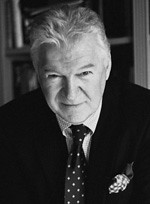
About the Author: (Photo Credit: Jerry Bauer)

Frank Delaney was born in Tipperary, Ireland. A career in broadcasting earned him fame across the United Kingdom. A judge for the Booker Prize, several of his nonfiction books were bestsellers in the UK, and he writes frequently for American and British publications. He now lives with his wife, Diane Meier, in New York and Connecticut. Ireland is his first novel to be published in the United States.


 This is my 11th book for the 2010 New Authors Reading Challenge.


My 1st book for the 2010 Ireland Reading Challenge.

FTC Disclosure:  I received a free copy of Venetia Kelly's Traveling Show by Frank Delaney from publicist Leah Paulos and Random House.  Clicking on title links or images will bring you to my Amazon Affiliate page; No purchase necessary.

Oct 27, 2009

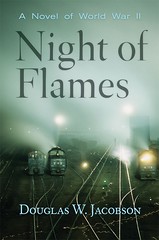
Night of Flames by Douglas Jacobson


Douglas Jacobson's Night of Flames is a gritty "spy" novel set during World War II beginning in 1939 during the invasion of Poland by the Nazis.  The main protagonists Anna and Jan Kopernik are separated by war and face near misses with the wrath of the Germans.  Anna joins the resistance in Belgium reluctantly, while Jan jumps at the opportunity to help MI6 on a secret mission in Poland with the hope that he can find his wife.

"Anna's eyes snapped open and she sat bolt upright.  The shrill sound blasted into her brain, penetrating through the fog of sleep like an icy wind.  She blinked and looked around the dark room, trying to focus on shadowy images as the sound wailed on and on."  (Page 11)

Anna is in Poland with her friend, Irene, and her son when the bombings start in earnest, leaving them and their driver very few options on the way back to Krakow and her father, a professor at the local university.  Anna is hit by significant loss and constant worry about her husband, who's career is with the Polish military.  Night of Flames is a fast-paced novel that pushed through the front lines and skulks in the shadows of the resistance.

"'The best thing any of us can do is try and keep out of their way, and if you get stopped or challenged, be as cooperative as you can.'

'So you're telling us to act like house pets in our own city.'" (Page 65)

Jacobson's no-nonsense writing style will place readers in the heart of the resistance, though some readers could get bogged down by the military strategy and direction, such as how the resistance used holes dug in the earth to hold lanterns that were lit to signal the Allies as to where to drop supplies.  Readers will either enjoy the detailed strategy or wish for a greater focus on the characters.  Anna is the most developed of the two protagonists, though Jacobson does give each nearly equal time through alternating chapters.  These chapters help build tension, leaving the reader in suspense as to whether they will ever be reunited.

Readers who enjoy learning about World War II and who enjoy spy novels will like this novel.  But Night of Flames is more than just a war novel; it is about how ordinary citizens can rise up to reclaim their homeland and their dignity in the face of adversity signifying an indelible human spirit.

Check out this video for Night of Flames:


I want to thank Douglas Jacobson, McBooks Press, and Pump Up Your Book Promotion for sending me a free copy of Night of Flames to review.  If you click on the title links, you'll be taken to my Amazon Affiliate page, but there is no obligation to buy.

They've also kindly provided an additional copy for one reader of my blog from anywhere in the world.  To Enter:

1.  Leave a comment on this post.
2.  Check out the War Through the Generations blog and leave me a relevant comment here about something you read or learned.

3.  Blog, Tweet, and spread the word about the giveaway and leave a comment here.

Deadline is Nov. 4, 2009, at 11:59 PM EST


This marks the 7th book I've read for the WWII Reading Challenge.  Though I officially met my goal of reading 5 WWII-related books some time ago, I've continued to find them on my shelves and review them here.  I'm sure there will be more, stay tuned.

Oct 22, 2009

The Last Dickens by Matthew Pearl


Matthew Pearl's The Last Dickens is one of a number of books about Charles Dickens' last, albeit unfinished novel, The Mystery of Edwin Drood.  But what sets this novel apart from its compatriots is Pearl's ability to build suspense and extrapolate from historical events to create a palpable underbelly of the publishing world.  

"A man stretched out on a crusty, ragged couch granted them admission into a corridor, after which they ascended a narrow stairs where every board groaned at their steps; perhaps out of despair, perhaps to warn the inhabitants."  (Page 199 of hardcover)

Charles Dickens' final, incomplete novel--he only completed six installments--caused a great deal of controversy as to whether the author indeed had not finished the manuscript, which in those days were released in installments.  Pearl mimics this method by breaking up the narration in separate installments from the Boston publishing house, Dickens' American tour, Dickens' son Frank in India at the height of the opium trade, and in England as Dickens' American publisher Mr. Osgood with his bookkeeper Rebecca Sand search for the lost installments and the true end of Dickens' final novel.

"At the top of the stick was an exotic and ugly golden idol, the head of a beast, a horn rising from the top, terrible mouth agape, sparks of fire shooting from its outstretched tongue.  It was mesmerizing to behold.  Not just because of its shining ugliness, but also because it was such a contrast to the stranger's own mouth, mostly hidden under an ear-to-ear mustache.  The man's lips barely managed to pry open his mouth when he spoke."  (Page 8 of hardcover)

Pearl includes an examination of the historical accuracies in the novel and which characters were pure fiction or modified historical figures.  One part mystery, one part historical fiction, and one part crime novel, The Last Dickens weaves a complex and detailed story that holds readers rapt attention from beginning to end.

While the chapters involving Frank Dickens' time in India uncovering an opium trade are not as prominent as some of the other narratives, it is intricately connected to the main story.  However, some readers could find these chapters frustrating because of the gap between those chapters, which could either leave readers frustrated that the tale of Frank Dickens is dropped or anxious for its conclusion.  Most readers are likely to err on the side of anxiety, wanting to know more.

"There are many reasons murder is not always found out, and they are not always for cunning.  The reason might be the fatigue among those who have been deadened on the inside."  (Page 264 of hardcover)

Osgood is not easily swayed when he is hot on the trail of the missing installments and the end of Dickens' novel, and as each layer of the mystery is peeled back for the reader, the dark, cutthroat publishing industry is revealed.  Bookaneers are the bottom feeders of the publishing industry, waiting on the docks for the latest installments from the Old World, while publishing giants from New York, like Harper, are eager to acquire these installments by any means necessary and at the expense of their competitors.

The Last Dickens is not just about an unfinished novel or the dark side of publishing.  It also takes a look at human conviction in the face of adversity and how perseverance and a moral compass can yield surprising results.  Pearl is a mystery master, and The Last Dickens will not disappoint its readers.


If you missed Matthew Pearl's guest post, check it out.  I want to thank Matthew Pearl, Random House and TLC Book Tours for providing me a free copy of The Last Dickens for review.

Click on the title links for my Amazon Affiliate purchasing pages.  

For an additional treat, check out this YouTube video:


For the giveaway for U.S. and Canada residents:  ***Just got word I have 2 copies available***

1.  Leave a comment on this post.
2.  Blog, Tweet, or Spread the Word for an additional entry.
3.  If you follow, get a third entry.

Deadline is Oct. 29, 2009 at 11:59 PM EST

Oct 14, 2009

The Tudor Rose by Margaret Campbell Barnes

Margaret Campbell Barnes' The Tudor Rose:  A Novel of Elizabeth of York is a historical novel that chronicles the final moments of Edward IV's reign in England and the usurpation of the thrown by Richard, Duke of Gloucester and later the conquest of England by Henry Tudor.

"Elizabeth came out of her own private thoughts with a start.  Her blue eyes stared almost uncomprehendingly.  During her short life she had become accustomed to being offered as matrimonial bait for some political reason or another; but the implications of her mother's words appeared to have neither rhyme nor reason."  (Page 55 of ARC)

Elizabeth of York, who is about age 17-19, is adrift in a family and country torn apart following the death of her father, Edward IV.  As she attempts to navigate the politics of a nation in turmoil and a family walled up in Westminster Abbey in sanctuary, she also has lost her sense of security and the love her father bestowed upon her willingly.  Throughout much of the book, Elizabeth vacillates from security and insecurity and reserve and outbursts.  In many ways, readers will find Elizabeth immature, particularly given her royal stature, and her character does not seem to improve much through out the novel--whether that is due to historical accuracy or not, it is unclear.

Despite the historical nature of The Tudor Rose, the narration flows like a contemporary novel and the dramatic revolving door of the kingdom is surprisingly easy to follow.  However, readers may find Elizabeth's actions a bit out of character in some places or seem to happen on a whim without much forethought, though the historical events in the novel follow what can be found on Wikipedia.  Barnes is a capable author of historical fiction, particularly of the Tudor period in England.  The Tudor Rose is a fast-paced read and will entertain readers with a series of plot twists.

Thanks to Sourcebooks and Margaret Campbell Barnes for sending me a free copy of this book for review.  

Sourcebooks has offered 1 copy of The Tudor Rose by Margaret Campbell Barnes for a lucky U.S. or Canadian reader.  To Enter:

1.  Leave a comment on this post about what time period you enjoy reading about in historical fiction.

2.  Blog, Tweet, or Facebook this post.

Deadline is Oct. 20, 2009, at 11:59PM EST

Sep 10, 2009

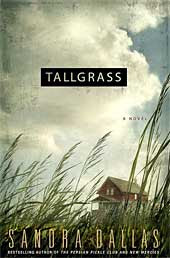
Tallgrass by Sandra Dallas

"I'd sneaked away from my parents and gone to the depot, too, because I'd never seen any Japanese. I expected them to look like the cartoons of Hirohito in the newspaper, with slanted eyes and buckteeth and skin like rancid butter. All these years later, I recall I was disappointed that they didn't appear to be a 'yellow peril' at all. They were so ordinary." (Page 2)

Sandra Dallas' Tallgrass is set in Colorado in 1942 just after the bombing of Pearl Harbor in Hawaii. The book is narrated by Rennie Stroud, who was a 13-year-old girl when the Japanese are rounded up and placed into an internment camp--known as Tallgrass Ranch--in Ellis, Colorado. Many of the Japanese in the camp just up from the Stroud's farm had been evacuated from their homes in California and their presence causes a major stir.

"They'd heard the sirens, too, and said it wasn't anything, but I feared that somebody had gone under the bobwire surrounding the camp and was going to break into our house and kill us." (Page 17)

Readers travel along with Rennie as she uncovers the truth about humanity regardless of color or creed and as she discovers the truth about her family. She grows into a woman more quickly than her parents would like, but given the rationing, the war effort, the harvest, and the increasing racial tension, Rennie has little choice but to mature.

"Things were tense even for the kids in the camp who never came in contact with people from Ellis. Little boys there played war games, just like the boys in Ellis. Daisy told us she'd watched a group of Tallgrass kids pretending they were fighting in the South Pacific and heard one complain, 'How come I have to be the damn Jap all the time?'" (Page 238)

Readers will enjoy growing along with Rennie and getting into trouble with her and Betty Joyce. Dallas does an exceptional job of rounding out Rennie's character from her naivete to her compassion and empathy for the plights of those less fortunate, like the Japanese and her friends. However, Tallgrass is more than a coming of age story; it also touches upon the harm caused by wrong-headed government policies, the fear that leads to prejudice and hatred, and the impact a war can have on everyone.

While readers may see some holes in how one of the main mysteries is resolved, Dallas' resolution is in tune with the narrator she chose, a 13-year-old who is not privy to serious adult conversation. Overall, Tallgrass is a novel about WWII, family, growing up, and learning how to build a community even when differences exist.


This is my 6th book for the War Through the Generations: WWII Reading Challenge.

Thanks to Staci at Life in the Thumb for reviewing Tallgrass with several other WWII books that I had to pick up from the library and read all together.

Also Reviewed By:
Adventures in Reading
Jo-Jo Loves to Read!!!
Life in the Thumb


Sep 9, 2009

The Day the Falls Stood Still by Cathy Marie Buchanan

Cathy Marie Buchanan's The Day the Falls Stood Still, like the Niagara River and the falls, flows powerfully with majestic danger. Elizabeth "Bess" Heath is a seventeen year-old woman on the brink of the falls contemplating the beauty of the river and feeling its power pushing her forward. Her family is well-positioned, but a turn of the current pushes them down river and leads to tragedy and redemption for Bess.

When she leaves her school life behind at Loretto Academy, she is thrust into adulthood and embarks upon a journey where she comes into her own, earning the pluck Tom Cole, grandson of the famous riverman Fergus Cole, sees in her during their brief encounters at the gates of Glenview.

"As he walks he holds his head in a way that makes it seem he is listening to the river. His intensity is such that to speak would be to interrupt. 'It's worked up tonight,' he says." (Page 15 of ARC)

Buchanan prose is calm, providing readers with an anchor amidst the rapids and whirlpools that threaten to toss Bess out on the streets and into the ditches emotionally and financially. Tom becomes her rock to which she anchors herself, and he provides her with focus, love, desire, and strength, just as the river does for him. However, with the outbreak of WWI and troops sent abroad to fight from Canada at the behest of Great Britain and the rise of hydroelectric power, Bess must find the strength on her own to survive without Tom's guidance and to care for their budding family.

"My Dear Bess,

I am sorry I've taken so long to write, but I have been putting it off, waiting for my mood to change. I am not sick in any way, but I am feeling beaten down--by the smell, the smashed men twitching like squashed charred insects the upright corpses mistaken for living men, the landscape of barren, earth without so much as a blade of grass. I am feeling alone, lost, and I can't figure out how to feel like myself again." (Page 183 of ARC)

As much as The Day the Falls Stood Still is about the impact of industrialization on the Niagara River, the falls, and the community, it also touches upon the environmental impacts of development, the loss of family, the dangers of progress, and the commitment of a man and wife to their family and their principles. Buchanan has created an emotionally charged novel based upon a real legendary riverman, William "Red" Hill. Complete with mock newspaper articles and historical photos and drawings depicting a variety of major events along the river from Bellini tightrope walking across the falls to the collapse of Table Rock.

Buchanan's debut novel is undeniably memorable for its historical references and emotional ties to Bess' family and the Niagara River. The Day the Falls Stood Still will haunt readers after the final page is turned.

Also Reviewed By:
Presenting Lenore


May 8, 2009

The Last Queen by C.W. Gortner

Welcome to the Savvy Verse & Wit tour stop for C.W. Gortner's The Last Queen, which is new in paperback this month.

About the Book:

Daughter of Isabel of Castile and sister of Catherine of Aragon. Married at sixteen and a queen at twenty-five. Declared mad by history. Juana of Castile, the last true queen of Spain. Ruled by her passions, Juana’s arranged marriage to Philip the Fair of Flanders begins as a fairytale romance when despite never having met before their betrothal, they fall violently in love. Juana is never meant to be more than his consort and mother to his heirs until she finds herself heiress to the throne of Spain after tragedy decimates her family. Suddenly she is plunged into a ruthless battle of ambition and treachery, with the future of Spain and her own freedom at stake. Told in Juana's voice, The Last Queen is a powerful and moving portrait of a woman ahead of her time, a queen fought fiercely for her birthright in the face of an unimaginable betrayal. Juana's story is one of history's darkest secrets, brought vividly to life in this exhilarating novel.

C.W. Gortner's The Last Queen is a roller coaster ride of emotion dramatizing Juana of Castile's adolescent years, her marriage to a man she doesn't know, and her return to her homeland. Juana is an impetuous child, independent, passionate, and compassionate. Her passions often lead her astray, cause her to act outside the norms of royal protocol, and jump to conclusions. While history views Juana as loca or mad, Gortner's dramatization examines possible explanations for her behavior. Juana witnesses the surrender of the Moors and Boabdil at the hands of her mother, Queen Isabel, as Spain reclaimed Granada.

"The lords closed in around him, leading him away. I averted my eyes. I knew that if he'd been victorious he would not have hesitated to order the deaths of my father and my brother, of every noble and soldier on this field. He'd have enslaved my sisters and me, defamed and executed my mother. He and his kind had defiled Spain for too long. At last, our country was united under one throne, one church, one God. I should rejoice in his subjugation.


Yet what I most wanted to do was console him." (Page 11, in the hardcover)


Shortly after Spain regains its footing, Juana is informed that she must marry the Archduke of Flanders, Philip, a man she was betrothed to and does not know. Juana is adamant that she will not marry this man, until her father treats her as an adult at sixteen and explains the political situation Spain is in and how her marriage to Philip could improve it. While she is young and passionate, she is frightened of the man she will marry and what married life entails. She's timid and accepting of her new life, which she discovers has more passion than she expected. However, even in this new, passionate existence, she is uneasy with her new role, the new customs she must learn, and the influence her husband's advisor, Besancon, has over Philip.

"She lay against mounded pillows, her eyes closed. I gazed on her translucent pallor, under which bluish veins and the very structure of her bones could be traced. A linen cap covered her scalp; her features seemed oddly childlike. It took a moment to realize she had no eyebrows. I had never noticed before. She must have had them plucked in her youth; those thin lines I was accustomed to seeing arched in disapproval were, in fact, painted. Her hands rested on her chest. These too I stared at, the fingers long and thin now, without any rings save the ruby signet of Castile, which hung loosely on her right finger. I hadn't realized how beautiful her hands were, how elegant and marble-smooth, as if made to hold a scepter.

The hands of a queen. My hands." (Page 201, in the hardcover)


Gortner's writing easily captures the fears of a young royal as she is shipped off to Flanders to be married. Readers will feel her apprehension and wish her well even as she boldly stares her fate in the eye. As the plot thickens against her and her homeland, Juana is fortified in her resolve and her passion girds her against the obstacles to come. Gortner's characters are well developed, leaping off the page to battle interlopers, defend their family's honor, and looking for justice when wrongs are committed by trusted advisors and family members. Readers will curl their toes in anxiety as Juana faces turncoats and ghosts and wish her triumph in the end. Overall, The Last Queen is an exceptionally well-crafted historical novel that will have readers dealing with a range of emotions from sorrow to anger. Gortner excels in building tension and leaving readers exhausted from the ride.

Also Reviewed By:
The Burton Review
Reading Adventures

ABOUT THE AUTHOR:

C.W. Gortner’s fascination with history is a lifetime pursuit. He holds a Masters in Fine Arts in Writing with an emphasis on Renaissance Studies from the New College of California and often travels to research his books. He has experienced life in a medieval Spanish castle and danced a galliard in a Tudor great hall; dug through library archives all over Europe; and tried to see and touch — or, at least, gaze at through impenetrable museum glass — as many artifacts of the era as he can find.

Ballantine Books, an imprint of Random House, publishes The Last Queens in trade paperback on May 5, 2009. A Random House Readers Circle Selection, it features a reading group guide and Q&A with the author. C.W. Gortner is also available for reader group chats by speaker phone or Skype.

Visit the author's Reading Group information.

He lives in Northern California. You can visit his Website.

***Giveaway Information***

1. 1 entry, comment on my review.

2. 1 entry, comment on this guest post, here.

3. Tell me if you are a follower or follow this blog and tell me for a 3rd entry.

4. Spread the word on your blog, etc., and get a 4th entry.

Deadline May 22, 2009, 11:59 PM EST

***THIS GIVEAWAY IS NOW CLOSED***


***Giveaway Reminders***

1 copy of Rubber Side Down Edited by Jose Gouveia, here; Deadline is May 15 at 11:59 PM EST

May 5, 2009

The Last Prince of the Mexican Empire by C.M. Mayo

Happy Cinco de Mayo! Today is the day to celebrate Mexican heritage and culture, and what an appropriate way to celebrate with my review of C.M. Mayo's in-depth look into one of Mexico's most turbulent times when its government was plagued by invaders (the Yankees and the French), in-fighting, and disease, like yellow fever.

The Last Prince of the Mexican Empire by C.M. Mayo and published by Unbridled Books is a historical novel that chronicles the short reign (about 3 years) of Maximilian, the undercurrent of political ambition, the clash of cultures, and internal familial machinations.

The novel opens in Washington, D.C., with Alice Green who meets and falls in love with Angelo de Iturbide, a secretary for the Mexican Legation. They marry and move to Mexico, where Alice (known as Alicia in Mexico) gives birth to their son, Agustín de Iturbide y Green. Leaving the Mexican shores, readers will journey across the Atlantic to Trieste, Italy, to meet Maximilian von Habsburg who reluctantly agrees to become the Emperor of Mexico. There are a number of nuances political and otherwise that can get confusing for readers unfamiliar with some of Mexico's history, but these instances are easily overcome as the story unfolds. It is clear from the use of multiple perspectives in this novel that the main character is not Maximilian, Agustin, Alice, Angelo, the Iturbides, the French invaders under Napoleon III, or the Republican upstarts led by Benito Juarez. The main "character" of this novel is Mexico and its future and how that future is shaped by all of these players, their decisions, and in some cases their indecision.

"There are eleven passengers, packed tighter than Jalapenos in a jar. Before reaching the coast, how long will they be trapped in this wretched contraption, two weeks? Five? The roads, if they can be called that, are troughs of mud. Last week La Sociedad reported that, past Orizaba, an entire team, eighteen mules, had fallen into the muck and suffocated." (Page 93)


Mayo is an impeccable researcher and craftswoman who fleshes out historical figures in a way that remains true to their historical actions and creates characters who are well-rounded and memorable for readers. Her ability to juggle multiple points of view is unparalleled--from the perspective of Agustin's nanny to Maximilian himself.

One of the most captivating sections of the novel occurs between pages 147-153 in which Maximilian is preoccupied with matters of state and the Iturbide family's sudden breach of a contract with the emperor with regard to their son Agustin. Mayo weaves in Maximilian's frantic thoughts, rants, and arguments with his physical tossing about in his bed, as he mashes the pillow into submission, kicks off the sheets, and sits upright in bed as he determines the best course of action to save face and depict Mexico as a strong nation.

Readers will agree that her prose is poetic, as she notes in her interview, here.

"Out the window, birds were being blown about in the sky, and in the distance, rain clouds draped like a filthy rag over the sierra." (Page 135)

Overall, this epic novel takes on a convoluted period in Mexico's history and the complicated families ruling or eager to rule in the mid-19th Century. Mayo does exceptionally well with multiple points of view, description, and character development to create a vivid dramatization. The Last Prince of the Mexican Empire would make a great book club selection and discussion.

Check out these images of Maximilian's Miramar Castle in Italy.
Check out these images of Maximilian's Chapultepec Castle in Mexico.

Check out an excerpt from The Last Prince of the Mexican Empire, here.

For book clubs of 12 members or more, please check out C.M. Mayo's guidelines for a telephone discussion with her.

Check out her book tour information to see if she'll be reading and signing books near you. Check out her 12 Tips on writing and publishing, here.

Also Reviewe By:
Caribousmom
Rose City Reader
Drey's Library
Devourer of Books

About the Author:

C.M. Mayo is the author of The Last Prince of the Mexican Empire (Unbridled Books, 2009), a historical novel based on the true story; Miraculous Air: Journey of a Thousand Miles Through Baja California, the Other Mexico (Milkweed Editions, 2007) and Sky Over El Nido (University of Georgia Press, 1995), which wonn the Flannery O'Connor Award for Short Fiction. Founding editor of Tameme, the bilingual Spanish/English) chapbook press, Mayo is also a translator of contemporary Mexican poetry and fiction. Her anthology of Mexican fiction in translation, Mexico: A Traveler's Literary Companion, was published by Whereabouts Press in March 2006.

Check back after May 17 for more goodies about C.M. Mayo's reading in Bethesda, Md., and a possible giveaway.

***Giveaway Reminders***

Giveaway for Eleanor Bluestein's Tea & Other Ayama Na Tales short story collection, here; Deadline is May 6, 2009, 11:59 PM EST.

1 copy of Rubber Side Down Edited by Jose Gouveia, here; Deadline is May 15 at 11:59 PM EST

May 4, 2009

Interview With C.M. Mayo, Author of The Last Prince of the Mexican Empire

Today is the kickoff for my Cinco de Mayo tour of C.M. Mayo's latest historical novel, The Last Prince of the Mexican Empire, which is set in the mid-19th century when Maximilian von Habsburg became the Emperor of Mexico, a little boy became a prince, and a struggle ensues over Mexico.

Please welcome C.M. Mayo to
Savvy Verse & Wit:

1. Between writing fiction, travel pieces,
translating work, and running Tameme, you are a very busy woman. Which of these "hats" do you find most difficult to wear and why? And do any of these "hats" conflict with one another?


I hope I am a better writer because I also translate, and vice versa, and so and so forth. But of course,
I sometimes have to make (even toe-curling) choices. Would that the day had 30 hours!

2. You've written fiction, nonfiction, and poetry throughout your career. Is there a reason why you haven't published a book of your poems? And how is each genre different or the same when you are crafting your pieces?

It's all poetry, I say. If not a book per se, I've published a book's worth of poetry, individual pieces in literary journals and anthologies, most recently, Robert Giron's Poetic Voices Without Borders 2. You can read that poem, here. Is there a reason I haven't published a book of poetry? Same answer as to question #1.

3. What set you on the path of translation and how would you describe the path you took to get there?

I started translating Mexican poetry in the early 1990s, a few years after I came to live in Mexico City. I was writing my own poetry and short fiction at the time, and so the one informed the other. I was --- and remain--- quite consternated by how little Mexican writing is translated into English. So I always try to encourage others, poets especially, to translate Mexican works.

I should note that in recent years there have been a few notable translations, including my own anthology of 24 Mexican writers, Mexico: A Traveler's Literary Companion (Whereabouts Press, 2006) and, most recently, Alvaro Uribe and Olivia Sears's Best Contemporary Mexican Fiction (Dalkey Archive, 2009), which includes one of my translations, of a story by Alvaro Enrigue.
Here's an interview on National Public Radio, "Editing a Literary Tour of Mexico."


4. Do you have any obsessions you would like to share?

Nope.

5. Do you listen to music while you write or is it distracting? If you could create a playlist of songs for The Last Prince of the Mexican Empire, what would be the top 5 songs on that list?

For me, drifty, new agey music in a minor key works best for bringing on the Muses. There is a large literature about music and creativity. I offer a couple of blog posts (with links for more information) on this subject here and here.

Playlist of songs for The Last Prince of the Mexican Empire:

1. "La Paloma" and "Adios Mama Carlota"
This is the most famous song associated with the Emperor Maximilian-- supposedly it was his favorite. There's a documentary film about the song, which you can read about here. Here's the protest song based on La Paloma, here.

2. Tritch-Tratch Polka by Johann Strauss; Popular Viennese dance music. This might have been played at one of the balls in Mexico City's Imperial Palace. Here's a link to an article by one of the guests, William Wells, "A Court Ball in the Palace of Mexico."

3. "Se fueran los los Yankis al Guaridame;" A children's lullaby, probably from the 1850s and still in use in the 1890s. The text is in Fanny Chambers Gooch's Face to Face with the Mexicans.

4. “Las Campanitas” (Mazurka), by J.D.R. Sawerthal; Sawerthal was a composer and band-leader who came to Mexico with Maximilian.

5. "Le Boudin," a military song composed in 1863 for the French Foreign Legion, which fought in Mexico. You can listen to the song, here.

6. You've taught at The Writer's Center in Bethesda, Md., what has that experience done for your writing and what goals did you seek to accomplish through your workshops?

I believe teaching is an important part of being an artist--- always, on multiple levels, a learning experience.

7. If writers want to use more than one point of view in a novel, how would you suggest they go about transitioning between the narrators? What tricks have you learned and are willing to share?

You need to cue the reader, give them something focus on, so they have a sense of where they need to put their attention in order to follow the narrative. You might have one character pass the other a cup of coffee, for instance. Sometimes, especially if it's a whole new scene, just leave a space.

For me learning to transition from one point of view to the other was like learning to ride a bicycle--- very difficult but, after a little practice, it becomes natural.

This is, in fact, one of the reasons it took me so long to write this novel. It has a Jamesian "roving central intelligence," which is a fancy way of saying it dips in and out of a multitude of points of view. In early drafts, I kept trying to get rid of characters-- but they did not want to go! And more kept popping up! Certainly it's easier to sell a novel with one main character. It's asking a lot of the reader to keep track of such a crowd. But I came to realize that all of these many characters are absolutely necessary for this story because the main protagonist is not a person but an idea: the prince is the symbol of the future of the empire--- the idea of Mexico as an empire, Mexicans not as citizens, but as subjects. How does the story of the prince--- the story of this idea---live, evolve and ultimately fail? We have to go into the minds of others to find out. There are a few important recurring characters, such as the prince's parents, his nanny, Maximilian, and Charlotte, but there are also a maid, a cook, a bandit, a visiting Belgian aristocrat, General Almonte and General Bazaine, the U.S. Minister to France, his wife, a bookseller, soldiers, Prince Louis of France, a dentist, the widow of a Mexican politician, Father Fischer, Cardinal Antonelli, the Pope-- yes! even Pope Pio Nono (Pius IX) --- and so on. You'll find a list of the whole crew, here.

8. How important do you think independent booksellers and publishers are in this age of digital media and do you see the paper-based book fading into the background in favor of an e-book or other format? If so, how would this change publishing for the better or worse?

Independent booksellers and publishers may confront economic challenges (certainly they are right now) but I believe they will always be necessary. They select and present--- perhaps not always ideally what we might like to see or what deserves to be seen--- but it is, nonetheless, an important service for readers.
Also, writers may not have the wherewithal to edit, design, distribute, publicize, or sell their books--- and that's exactly what publishers and booksellers do.

What do I think will happen? I think we'll see more options: in the bookstores themselves we may soon see vending machines that can print on demand, perhaps while you have a cup of coffee. You might have various options of varying cost: for instance, e-book, cheap paper, acid-free paper, or hardcover. I believe there will always be a demand, however reduced, for quality hard-cover books. We still have horses and candles, after all. Right now, with the crisis, there are probably more people going to libraries--- and libraries need to have durable books, not cheap things that fall apart after 2 readings.

9. How do you stay fit and healthy as a writer?

Yoga, walking and sleep. It's also very important to stay away from industrially-produced food and "diet" drinks, which are full of chemicals. What you eat ends up in your brain.

10. Most writers will read inspirational/how-to manuals, take workshops, or belong to writing groups. Did you subscribe to any of these aids and if so which did you find most helpful? Please feel free to name any “writing” books you enjoyed most (i.e. Bird by Bird by Anne Lamott).

Here's a link to a piece I did for ForeWord Magazine on-line column "Publishing Insider"

For the Novelist's Bookshelf: One Dozen Books on Craft and Creating

11. What current projects are you working on and would you like to share some details with the readers about your writing space and/or routine?

I'm working on a new novel, but don't have much to say about it yet. About space and routine, here are
"10 Tools for Organizing a Novel in Progress," here.

I want to thank C.M. Mayo for taking time out of her busy schedule to answer my questions. Stay tuned for my review of
The Last Prince of the Mexican Empire tomorrow.

Also, C.M. Mayo will be in Bethesda, MD, promoting her book at The Writer's Center on May 17 at 2PM for those locals interested. This is a free event.


***Giveaway Reminders***

5 Joanna Scott, author of Follow Me, books giveaway, here; Deadline May 4, 11:59 PM EST.

Giveaway for Eleanor Bluestein's Tea & Other Ayama Na Tales short story collection, here; Deadline is May 6, 2009, 11:59 PM EST.

1 copy of Rubber Side Down Edited by Jose Gouveia, here; Deadline is May 15 at 11:59 PM EST

Apr 27, 2009

Follow Me by Joanna Scott

Welcome to the April Hachette Group Early Bird Blog Tour for Joanna Scott's Follow Me.

About the Book (From Hachette Website):

On a summer day in 1946 Sally Werner, the precocious young daughter of hardscrabble Pennsylvania farmers, secretly accepts her cousin's invitation to ride his new motorcycle. Like so much of what follows in Sally's life, it's an impulsive decision with dramatic and far-reaching consequences. Soon she abandons her home to begin a daring journey of self-creation, the truth of which she entrusts only with her granddaughter and namesake, six decades later. But when young Sally's father--a man she has never known--enters her life and offers another story altogether, she must uncover the truth of her grandmother's secret history.

At more than 400 pages, Joanna Scott's Follow Me is a very detailed account of Sally Werner's background as told by her granddaughter, Sally. Scott has a gift for detail, which can become a drawback when Sally Werner is wandering in the woods after leaving her baby with her parents. The twists and turns Sally's life takes are driven by her fear and her desire to fit in without revealing her true self in each new location, but often the poetic prose gets in the way. It isn't until page 53 that readers discover Sally has red hair, and readers find this out at the moment when Sally is getting her hair dyed blond. Scott's writing vacillates from run-on sentences to short fragments, both of which readers may find slow down the plot.

"Running, Running, Running up the jagged slope behind the rows of new corn, over the stone wall, through the woods and meadows. Sting of nettles. Gray sky of dawn. Bark of a startled deer." (Page 15)


In some cases, the narrative opts for telling the reader what's going on, rather than showing the action and development through character interaction. Moreover, detailed backgrounds of side characters like Gladdy Toffit are asides that do not propel the plot or character development forward.

"Other days she'd [Gladdy] dress in one of the three rayon skirt-suits she owned, gather bills from the rolltop desk in the living room, and get in the car and drive to the bank in Amity to confer with the person she called her financial adviser. Late in the afternoon she'd come back home to pour her bourbon, urging Sally to join her because, as she claimed, she didn't like to drink alone." (Page 119)

Scott introduces Mole into Sally's life, and that's when readers will begin to cheer her on, hoping she will take this new opportunity to turn her life around, grab onto her responsibilities, and emerge a stronger woman. When these characters come together, the scene is full of playful tension and drama as he and his friends sit in a room playing Russian Roulette.

"It was similar to a dream, inevitable and natural and illogical. A slanting light shone from the lantern; the radio crackled its song; the river splashed; the crickets chirped; the tension made breathing impossible; the air was so thick the boy could hardly lift his arm, raising the gun to his head in an attenuated motion, the effort exhausting him, drenching him in sweat, the heat of fear turning his pale skin into melting wax." (Page 104)


About halfway into Follow Me--which as a title works well for this journey type of novel--the drama heats up forcing Sally Werner to make a tough choice, and these scenes were the most vivid and well crafted. These scenes are the most vivid because they propel the plot, they are full of action, and you are right there with Sally in the thick of it, watching how these events bring out her inner strength and how they are bound to impact and force her to take conscious action.

"It meant she had to cover her face, so the next time he hit her his knuckles struck the back of her hand, bouncing her head away from him but not actually hurting her, which only enraged him more, and with a swift movement he yanked her arm away . . . his fist caught her in the mouth, driving into her gullet, shattering bone, filling her vision with a blank darkness that matched the sky." (Page 206)

"But Sally could guess what the sound signified and looked up in time to catch a glimpse of Leo leaping from the peaked roof above the door. But she didn't know he had landed on Benny Patterson until she felt her attacker veer backward. He would have pulled her with him if she hadn't ripped herself free from his grasp. He stumbled, tripped over the corner of the step, and as the cat leaped forward, Leo's weight exacerbated Benny's fall; he plunged backward, his feet came out from under him, and his head snapped hard against the brick wall of Potter's hardware.
" (Page 208)

Overall, it takes a long time to be drawn into this book, and readers may have a difficult time getting a fix on Sally Werner's character. It was hard to feel sympathetic toward her when many of the problems she faces are self-created and she often portrays herself contrary to her own actions. For instance, she considers herself a hard worker and reliable, but she gives birth and leaves her child within 24 hours of bringing him into the world, which is not a prime example of a reliable woman. Scott's prose is beautiful, but readers can easily lose their footing in the world Scott tells rather than shows her readers. Clearly, Scott is a gifted writer and uses description well to create a vivid scene, but this story may have worked better if it was told in a different way. Those readers who enjoy generational novels and coming of age stories may be interested in this novel unless they have a rough time with overly descriptive novels.

About the Author:


Joanna Scott is the author of nine books, including The Manikin, which was a finalist for the Pulitzer Prize; Various Antidotes and Arrogance, which were both finalists for the PEN/Faulkner Award; and the critically acclaimed Make Believe, Tourmaline, and Liberation. A recipient of a MacArthur Fellowship, a Guggenheim Fellowship, and a Lannan Award, she lives with her family in upstate New York.

Some of the Hachette Group Early Birds Blog Tour Participants:


Peeking Between the Pages
Bermudaonion
My Friend Amy
S. Krishna's Books
Booking Mama
The Tome Traveller
Diary of an Eccentric
A Novel Menagerie
Necromancy Never Pays
Caribousmom
Drey's Library
Redlady's Reading Room
The Burton Review
A Bookworm's World
Jenn's Bookshelf

***Giveaway Details***

Hachette Group has offered one lucky U.S./Canadian reader a set of Joanna Scott's books: Follow Me, Make Believe, Everybody Loves Somebody, Liberation, Tourmaline.

1. One entry, leave a comment on this post other than "pick me" or "enter me"
2. Second entry, blog, Facebook, Twitter, or spread the word and leave a link or comment on this post that you've done so.
3. Third entry, follow this blog and let me know.

Deadline is May 4, 2009, 11:59 EST.

*** Giveaway Reminder***

Don't forget to enter the Keeper of Light and Dust giveaway, here and here. Deadline is April 28 at 11:59 PM EST.


There's a giveaway for 5 copies of Girls in Trucks by Katie Crouch, here; deadline is April 29, 2009, 11:59 PM EST.

A giveaway of The Mechanics of Falling by Catherine Brady, here; Deadline is May 1 11:59 PM EST

Apr 16, 2009

Interview With Susan Higginbotham, author of The Traitor's Wife

Hello. I would like to welcome Susan Higginbotham, author of The Traitor's Wife, which I reviewed here, to Savvy Verse & Wit.

She was kind enough to take some time out of her schedule to answer some great writing questions. Please give her a warm welcome.

1. How would you introduce yourself to a crowded room with audience members eager to hang on your every word? What would you disclose? What would you keep secret? and why?

Well, if it’s a secret, I wouldn’t tell it here, would I? I’m not a let-it-all-hang-out person, so I’d probably talk about my books and/or the history behind them and crack a few jokes.

The most successful speech I ever made was in law school when as an exercise to get us used to arguing in front of a jury, the professor had us get up and tell a story about ourselves. I told my classmates about the time I had gone to my college library to study for my biology exam and the man sitting in the seat near me exposed himself, which was a bit too much biology for me. My classmates loved it.

2. Do you have any writing routines or habits?

I try to write pretty diligently once the family goes to bed, and I have my writing space all to myself. It’s hard to avoid the temptation to surf the Internet instead of staring at a blank monitor, but I’m getting more disciplined.

3. Do you have any obsessions that you would like to share?

Aside from medieval history, I’m passionate about Coca-Cola, Barbie dolls, old graveyards, Mini-Coopers (I don’t own one, but I love to admire their sheer cuteness), checking my Amazon ranking, and finding new ways to waste my time on the Internet. (Don't we all have this problem? I know I do.)

4. Most writers will read inspirational/how-to manuals, take workshops, or belong to writing groups. Did you subscribe to any of these aids and if so which did you find most helpful? Please feel free to name any "writing" books you enjoyed most (i.e. Bird by Bird by Anne Lamott).

I used to read Writer’s Digest and The Writer every month when I was in my teens and twenties—which was a couple of decades ago--but I finally stopped. I think after a while the advice just started getting repetitive. I began to concentrate more on reading novels and noting what techniques worked for me as a reader and what didn’t work—I found that helped me as a writer immensely.

5. When writing The Traitor's Wife, did you have a specific list of songs that you listened to; if so what would be the top 5? Or if you could choose a list of five songs to represent your work, what would they be?

I don’t listen to music while I write; I find it too distracting, but I did find that I tended to associate certain songs with The Traitor’s Wife. I’m going to be lazy and give you a link to the interview Julie K. Rose did for me, where I listed five songs back when the writing process was fresher in my mind.

Now that I have an iPod like the rest of the civilized world, if I was asked this question with regard to my current work in progress, I could answer in a flash! Back then I was at the mercy of whatever was playing on the radio.

6. In terms of friendships, have your friendships changed since you began focusing on writing? Are there more writers among your friends or have your relationships remained the same?

My core relationships have pretty much stayed the same, but I’ve met some great folks online, writers and readers alike, through my novel. It is nice to have other writers to whine to. (AMEN!)

7. How do you stay fit and healthy as a writer?

I don’t have any of the epic bad habits associated with writing—no booze, no drugs, no cigarettes. It’s awfully tempting when I’ve had a good writing spell to reward myself with a nosh, however—writing can be very dangerous that way. I try to work out once a week, at least in theory, and the dog and I take a nightly walk together. Thank goodness he’s not a cat or I’d never get any exercise. (I've now got a new-to-me word for Wondrous Words Wednesday; can you guess what it is?)

8. Do you have any favorite foods or foods that you find keep you inspired? What are the ways in which you pump yourself up to keep writing and overcome writer's block?

I have an extremely limited diet, with Coca-Cola and pork being the main staples. I’m picky; it’s a family legend.

Having a blog is a great way to avoid writer’s block. If I’m not working on my novel, I can at least find something to blog about, even if it’s just doing a meme.

9. Please describe your writing space and how it would differ from your ideal writing space.

Ideally, I would have a book-lined study in a city brownstone with the soothing noise of traffic outside my window. (I would enjoy this writing space as well)

In reality, I have a corner of the kitchen of my small suburban home in which to write, with no doors to close against the noise from the rest of the house. Because of that, I do most of my writing when the rest of the family is sleeping.

10. What current projects are you working on and would you like to share some details with the readers?

I just finished the first draft of my third novel, which is set during the Wars of the Roses. It bucks a trend in that it’s not particularly sympathetic toward Richard III. It’s narrated by Henry Stafford, the Duke of Buckingham, and his wife, Katherine Woodville, sister to Queen Elizabeth Woodville. It’s been quite fun to write, and I’ve gotten into some great (mostly friendly) arguments during the process.

Thanks for the interview! I loved these questions, once I got into the swing of them.

Thank you, Susan, for answering these unusual questions. What did you think of Susan and her answers?

***Giveaway***

I have 3 copies for U.S./Canada residents available from Sourcebooks and 1 copy, my gently used ARC, for an international recipient.

1. Please leave a comment here on my review about your favorite historical novel for 1 entry.

2. For a second entry, come back tomorrow and leave a comment on my interview with Susan Higginbotham.

3. Spread the word about the giveaway and leave a link on this post for a third entry.

***Remember to leave your email address and indicate if you are international in your comments***

Deadline is April 22 at 5PM