Showing posts with label nonfiction. Show all posts

Nov 17, 2009

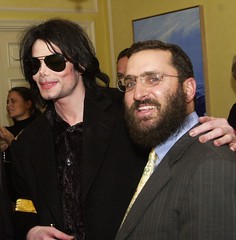
The Michael Jackson Tapes by Rabbi Shmuley Boteach


"MJ:  Everybody's funny bone is the same color, isn't it? We are all the same, really.  I have seen that a lot."  (Page 258)

Rabbi Shmuley Boteach's The Michael Jackson Tapes is a unique look at a larger-than-life celebrity musician in an intimate setting, but portions of the book are written like a thesis or an examination of celebrity and its adverse impact on America and its stars.  This is not a book for those looking for pictorial depictions of the star in his home or seeking titillating details about his personal relationships with women, his children, or other family members.  While family is talked about, it is not the crux of this book nor of the taped conversations between Jackson and Boteach between 2000 and 2001.

"And it's heady stuff to be needed by a global superstar.  It makes you feel important and special and soon you close your eyes to all you know to be righteous.  The glow of fame is too bright, the gravitational pull of celebrity too difficult to resist, until you have become nothing but a satellite in its orbit.  All resistance has been quelled by the superpowerful narcotic of superstardom."  (Page 269)

Through these recorded conversations with his acquaintance and spiritual guide -- at least for a time -- Michael Jackson revealed some of his demons, his joys, and his fears.  But even for all the explanations by the author of his convictions about Jackson's innocence and sincerity, there are times when readers will uncover something amiss with Jackson -- whether from the drugs or other influences is anyone's guess.  Answers to certain questions will start off coherent and then reach the absurd, leading readers to wonder how the Rabbi failed to see something wrong with Jackson (i.e. drug abuse).  Boteach knew Jackson for just a few years, and while readers may take issue with his assessments of the celebrity or the closeness of their relationship, readers will see a side of Jackson rarely shown to the public.

"MJ:  See, why can't we be like the trees? That come, you know, they lose their leaves in the winter, and come back as beautiful all over again in the spring, you know? It's a sense of immortality to them, and the Bible says man was meant for immortality."  (Page 67)

Jackson and Boteach discussed religion, family, fame, celebrity, and many other topics, with the goal of creating a book.  Jackson at one point espouses the need for celebrities to be responsible for their public displays and shows to ensure they send an appropriate message to their fans, but in many ways acted contrary to that message (i.e. grabbing his crotch during concerts, which he says he did not do consciously).

However, there are times when this book grows tedious with the repetition of Boteach's theories and assessments of Jackson's actions and past; it is almost like he doesn't trust the reader to make his or her own assessments about Jackson and his downfall, which is a major drawback.  Readers will absorb and get lost in the conversations between Boteach and Jackson and enjoy the snippet of conversation included with Jackson's mother.  The Michael Jackson Tapes seeks to bring out the flaws and the good qualities in a wayward superstar lost in his own image.

About the Author:

Rabbi Shmuley Boteach is host of the award-winning national TV show, Shalom in the Home on TLC. He is also the international best-selling author of 20 books, including his most recent work, The Kosher Sutra: Eight Sacred Secrets for Reigniting Desire and Restoring Passion for Life (Harper One). His book Kosher Sex was an international blockbuster, published in 20 languages, and his recent books on the American family, Parenting With Fire and Ten Conversations You Need to Have With Your Children were both launched on The Oprah Winfrey Show.

I want to thank FSB Associates, Vanguard Press, and Author Rabbi Shmuley Boteach for sending me a free copy of The Michael Jackson Tapes for review.   Clicking on cover images and titles will bring you to my Amazon Affiliate page; no purchases required.

I have 1 copy for 1 lucky reader anywhere in the world.  To Enter:

1.  Leave a comment on this post about your fondest memory of Michael Jackson or The Jackson Five.

2.  Blog, tweet, Facebook, or otherwise spread the word about the giveaway and leave a comment here.

Deadline is Nov. 23, 2009, at 11:59 PM EST

Oct 5, 2009

The Woodstock Story Book by Linanne G. Sackett and Barry Z. Levine


The Woodstock Story Book by Linanne G. Sackett and Barry Z. Levine is much more than photographs of the infamous peace concert called Woodstock.  It's a chronicle of the festival from its inception to its completion.  Levine's images are immediate, palpable, and candid, while Sackett's storytelling is clipped, providing only the essential details readers will need to grasp the photos before them.  The foreward, written by Wavy Gravy, discusses the nostalgia he felt after seeing the book in its completion, and he notes that even though the outdoor festival ended, the principals and dreams of Woodstock live on.

"People, who were called freaks because of their hair and their way of dressing, came to Woodstock and they said, 'Holy smokes.  We're all freaks' and they began to embrace that term.  There were a lot of people who opposed the Viet Nam War that thought they were alone.  They looked around and realized that they weren't alone--that there were a half a million people who felt the same way," Wavy Gravy says in the book.  (Page 3)


Through poetic lines, The Woodstock Story Book tells a lyrical account of the days leading up to the festival, the struggles with locating a large enough venue, and the community created in just a few days.  The festival's stages were not even completed before the crowds started arriving.  Check out this crowd shot from Barry Levine's Web site.

"They Stood for their truth
and pointed out lies

They were accused of
Communist ties"  (Page 40)

The Woodstock Story Book is an essential photographic history of a tumultuous time in our nation's history.

From my D.C. Literature Examiner preview of the book (check out the full article):

This 40th anniversary, collector's edition provides readers with a backstage pass to the best outdoor event in our nation's history.  Even after 40 years, the Woodstock experience in Bethel, New York, between Aug. 15 and Aug. 18, 1969, continues to capture the imagination.

With never-before-seen photos of Jimi Hendrix, Janis Joplin, Jerry Garcia, and more, The Woodstock Story Book tells a chronological story of the music festival that became one of Rolling Stone's 50 Moments That Changed the History of Rock and Roll.  There are over 300 full-color photographs in this book and are accompanied by humorous descriptions of the festival.  Great for those who remember Woodstock, wished they had been there, or are interested in rock and roll history.

For more information, check out The Woodstock Story Book blog.

Thanks to Lisa Roe at Online Publicist for sending me the book to review.

Jul 17, 2009

Rubies in the Orchard by Lynda Resnick

"Take a hike with me. Follow your dreams." (Page XX)

Lynda Resnick's Rubies in the Orchard is one part marketing strategy, one part personal story, and one part how-to formula. Resnick is a woman of direct experience in the rough-and-tumble world of advertising and marketing, and her chops shine through in this nonfiction book. She and her husband have successfully resurrected Fiji Water, Teleflora, and The Franklin Mint, but one of their best successes---POM--blossomed from a group of pomegranate orchards her husband bought years before.

Rubies in the orchard are the intrinsic value of products, and these are the values that must be communicated to customers, says Resnick. Following each marketing anecdote--from her days as a small business owner amidst scandal to her very profitable empire of companies--Resnick offers sage marketing advice that can be used not only in the boardroom and executive offices, but at home too. For example, she says, "You get a lot further in life by showing what you don't know and asking for help than you do pretending you know it all" (Page 24).

Throughout this delightful book, Resnick boxes out the main points she is trying to hit home with readers, and these little reminders keep her examples fresh in mind. Readers will be particularly astonished about how a set of fake pearls worth $34 at the time of purchase ended up being auctioned off for more than $200,000, and how those pearls became integral to Resnick's success at The Franklin Mint.

Marketing and advertising could be viewed as boring by some readers, but Resnick's wit shines through in this success story.

"He had a habit of making the financials look rosier than they actually were. . . . but the poor chap was so accustomed to manufacturing crooked numbers each quarter. . . If he had exhibited a drinking or substance abuse problem, we could have sent him to rehab, but where do you send a recidivist hooked on funny financials?" (Page 76)

While some aspects of Rubies in the Orchard may come off as preachy, particularly for conservatives not sold on the reality of global warming, she does make a viable points about why businesses should go green. Readers who are interested in an autobiography or learning more about the marketing world would be pleased with this fast read.

If you are interested in this book, I'm giving away my copy to one lucky reader. Just leave a comment below.

Deadline is July 24, 2009

Jun 2, 2009

Fodor's New York City 2009 Guide

Fodor's New York City 2009 came to me from Shelf Awareness in preparation for Book Expo America. I requested the guide to make plans for navigating the city, and it was a great resource for the trip this past weekend.

There are full-color pages throughout of various landmarks, monuments, and other places. There is a pull out map inside with clearly labeled streets and landmarks, as well as a subway system map in the back flap for Manhattan. The subway map helped during the trip to determine which line of the subway to take to our destinations, including to the hotel from Penn Station and from the hotel to the Greenhouse.

Anna and I did pick out a few things to see while in the city, but unfortunately, I revisited Times Square and not much else. Anna saw Times Square for the first time, though it was incredibly crowded. At one point during the day on Friday, we walked by and found Broadway closed off and lawn chairs spread out. According to my friend and photographer, Mike, the lawn chairs are part of a program to get people in office buildings out into the sun during the day, allowing them to breathe in the fresh air.

Fodor's guide is chock full of information about the subway system, its costs, fare cards, and other transportation needs, including appropriate tip amounts for taxis, bellhops, and others. I would highly recommend this guide for those taking a trip to New York City; it provides a comprehensive resource for those looking to see as much as they can in the city that never sleeps. I know I'll be using this guide again when I take my next trip to the city.

Don't forget these great giveaways:

3 copies of Mating Rituals of the North American WASP by Lauren Lipton, here; Deadline is June 3, 2009, 11:59 PM EST.

1 copy of Reunion by Therese Fowler, here; Deadline is June 4, 2009, 11:59 PM EST

Dec 19, 2008

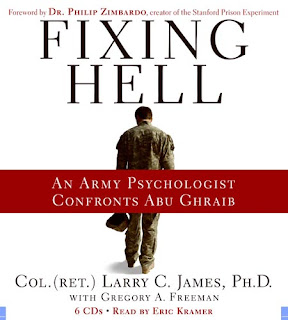
Fixing Hell by Col. (Ret.) Larry C. James, Ph.D.

Fixing Hell by Col. (Ret.) Dr. Larry C. James, Ph.D. is a nonfiction book about how one army psychologist takes on the task of cleaning up after public relations nightmares at detention centers in Guantanamo Bay, Cuba, and Abu Ghraib, Iraq.

Dr. James is sent to reform these prison/detention centers after scandals break out regarding the treatment of prisoners and detainees. After conducting research and reviewing the Stanford Prison Experiment, which details how otherwise "good" people can commit atrocities in a prison system, Dr. James heads to Cuba.

He outlines some ground rules before he gets to Guantanamo Bay. One of the main rules he sets forth is that leaders must be seen and present. James walks throughout the complex at different hours of the day, even at 2 a.m. He finds that some of the guards on duty in the wee hours are asleep at their posts, while others claim to have never seen a colonel or other military leaders.

Dr. James leaves Guantanamo only to be sent shortly thereafter to Abu Ghraib following the highly public denigration of Iraqi prisoners at the detention center. Soldiers at the prison disrobed prisoners, posed them naked in a human pyramid, and shot photos of the incidents, which were later plastered all over the news. As a psychologist, Dr. James was sent to the detention center to clean up the facility and establish protocols to prevent further incidents.

The audio of this book was well read and engaging. It certainly kept our attention during our early morning commutes, and it was intriguing to get an insider's look at the military's psychology department and protocols. My husband enjoyed the details about how Dr. James remedied the problems at Abu Ghraib and the insight those details provided about the actual facts of the situation.

However, the last chapters of the book slowed down the flow of the book for us. Dr. James offers a great deal of explanation about how the media played up the Abu Ghraib incidents and printed misinformation that maligned the reputations of fellow psychologists and himself. While we understood his need to set the record straight, the information was unnecessary given the timeline he issued throughout the book. Any reports placing him or his colleagues at the detention centers during the scandalous incidents could easily be dismissed.

With that being said, anyone interested in military or war history will enjoy this insider's look at the Iraq War, Abu Ghraib, and the military's psychology unit.


About the Author:

Colonel Larry C. James, PhD, served as the Chief, Department of Psychology at Walter Reed Army Medical Center for the past five years. In this capacity, he also was the Chief Psychologist for the Army's northeast region and had responsibility over 100 psychologists in this region. Currently, Dr. James is the Chief, Department of Psychology, Tripler Army Medical Center, Honolulu, Hawaii. During the Military's response to 9/11 at the Pentagon, Col. James was the Chief Psychologist for the Mental Health Task Force. Dr. James has been awarded the Bronze Star and the Joint Service Commendation medals for his superior and distinguished services during the global war on terrorism. In 2003, he was the Chief Psychologist for the Joint Intelligence Group at GTMO, Cuba, and in 2004 he was the Director, Behavioral Science Unit, Joint Interrogation and Debriefing Center at Abu Ghraib, Iraq. Col. James was assigned to Iraq to develop legal and ethical policies consistent with the Geneva Convention Guidelines and the APA Ethics Code in response to the abuse scandal. Also, while at Abu Ghraib, Iraq, Dr. James was tasked with developing a mental health clinic to deliver services to approximately 8,000 prisoners.

***Don't forget my giveaway for an inscribed copy of Matrimony by Joshua Henkin. Deadline is Dec. 21 and the contest is international.**

***Check out the winner of the Green Beauty Guide and an announcement about First Book.***

Dec 18, 2008

Against Medical Advice by James Patterson

James Patterson and Hal Friedman's Against Medical Advice is the first book my mom, Pat, will be reviewing here on Savvy Verse & Wit.

According to Amazon.com's Product Description:

Cory Friedman woke up one morning when he was five years old with the uncontrollable urge to twitch his neck. From that day forward his life became a hell of irrepressible tics and involuntary utterances, and Cory embarked on an excruciating journey from specialist to specialist to discover the cause of his disease. Soon it became unclear what tics were symptoms of his disease and what were side effects of the countless combinations of drugs. The only certainty is that it kept getting worse. Simply put: Cory Friedman's life was a living hell.

Against Medical Advice is the true story of Cory and his family's decades-long battle for survival in the face of extraordinary difficulties and a maddening medical establishment.

Without further ado, here's mom:

Patterson usually writes fiction, but this non-fiction work is well written. Patterson and Hal Friedman met at an advertising agency and both are writers. They took four years to write this true story about Hal's son, Cory, who has Tourettes Syndrome. One symptom of the ailment is body ticks. After a variety of medical treatments and medications, symptoms were not alleviated and lead to Cory's over-eating and weight gain.

Cory, an athlete in school, eventually gets into trouble with the "wrong" crowd. Alcohol consumption exacerbates Cory's medical problems and things spiraled out of control for him. After a number of treatment facilities, Cory is sent to a wilderness camp to help him cope with his ailment.

This is a story of one family's struggles with a disease that is hard to treat and deal with, and about how this struggle impacted them. I would recommend this book to James Patterson fans and would consider this among his best books. I consider this as a 5-star book.

Thanks mom for your review of James Patterson's Against Medical Advice.

Pat is an avid James Patterson reader and loves to follow his latest novels. I even thanked James Patterson in person for getting my mom to read. She didn't read much when I was growing up, at least from what I can remember. Now, if we could only get dad to start reading.

***Don't forget my giveaway for an inscribed copy of Matrimony by Joshua Henkin. Deadline is Dec. 21 and the contest is international.**

***Check out the winner of the Green Beauty Guide and an announcement about First Book.***

Dec 17, 2008

You Lost Him at Hello by Jess McCann

Jess McCann's You Lost Him at Hello is part of a TLC Book Tour and I want to thank TLC and Jess McCann for sending along the book for my review.

Despite being married myself, this book has some great advice about how to embrace yourself and become confident--know your product and learn how to sell it. In the dating world, confidence is everything, even if you don't feel confident all the time. McCann lays the groundwork for each single woman in this book, seeking to provide practical applications of sales techniques in the dating world.

The best part of this book is the personal stories of her own dating snafus and those of her friends. These tidbits bring the practical advice to the forefront, detailing how the techniques can be applied to improve each woman's dating life. While a lot of self-help books talk about making drastic changes to your routines and lifestyles in many instances, McCann offers some small steps you can take to get results. Check out Adventures of Wanderlust's post to see how small changes worked for her and her girlfriends.

Here are some main things to keep in mind, which may seem like common sense:

1. Know yourself and love yourself
2. Remain confident and share your opinions
3. Make eye contact and express interest in discussed topics, even those outside your comfort zone
4. Don't be a telemarketer of dating; you cannot convince a man to be interested if he isn't
5. Make yourself available and change up your routine to meet guys in a variety of places to prime the pump--keeping your options open until commitment is broached

I wanted to share this passage with you from McCann's book, page 37:

My friend Kayla is the worst dater. . . . Kayla's biggest problem is that she doesn't really know who she is. She hasn't yet figured out the kind of person that makes her Kayla. If you asked her if she was a Democrat or Republican, she would say that she's not into politics. . . . She thought she was being easygoing by staying neutral, but instead she came off looking like she wasn't smart enough to form her own opinion.

This book provides personal stories, saleswoman insights, and tips on how you can change how you interact and attract men. My favorite icebreakers are on page 75:

That drink looks good, what is it? (don't most men drink beer?)
Didn't you go to my high school?

One of McCann's friends likes to ask guys if they've ever been waxed. Now that is one I certainly never would have thought to use.

While some of the advice in this book is common sense, other advice will help those who are still single and tired of playing games, getting dumped, and living in love limbo. There is some great insight into how to gauge men's interest from how they look at you, converse with you, and how they interact with women.

I highly recommend this book for women who want to change their dating outcomes and find a steady relationship that will fulfill them and make them happy. I also think that this book has wider applications for women, teaching them how to become confident and skilled at engaging others in conversation not only on dates, but in friendships and the business arena. McCann does an excellent job of weaving advice into personalized experiences to engage the reader and help her own the lessons inside these pages.

Check out the next stop on the tour, Life in Pink.

About the Author:

Jess McCann is unlike any dating coach out there. Instead of the usual therapy-based date coaching, Jess takes a unique approach to finding and keeping the right person for you. Through her education and experience in business, she has made the remarkable discovery that dating is really a simple series of techniques that anyone can learn and succeed with.

At thirty years old, Jess was on top of the world. After graduating college, she had started her own sales company, where she single-handedly recruited, trained and managed a thirty-person sales team. She was chosen as one of America’s top entrepreneurs by Sir Richard Branson and traveled the world on his Fox reality show, The Rebel Billionaire. Having discovered first-hand that the art of sales directly translated into her dating life, Jess began counseling women, teaching them logical and proven sales techniques that they could use on their own dates. She continues to teach the fundamentals of sales and dating to women across the country.

***Don't forget my giveaway for an inscribed copy of Matrimony by Joshua Henkin. Deadline is Dec. 21 and the contest is international.**

***Stay tuned for The Green Beauty Guide winner, which I'll post tomorrow, Dec. 18.***

Dec 9, 2008

Green Beauty Guide by Julie Gabriel

Most women will look in Cosmo or other beauty magazines for the latest cosmetic and fashion tips, but what many of these magazines don't tell you is that the products manufactured by these companies are using chemicals and other compounds that once your skin absorbs them could cause other ailments or problems. While I don't readily wear makeup or use cosmetics, I gladly took on a TLC Book Tour stop for Julie Gabriel's The Green Beauty Guide. I love holistic looks at our everyday lives and books that seek to provide an alternate perspective to how we live our lives whether its from turning holiday celebrations green or learning how to reduce our own carbon footprints.

The Green Beauty Guide goes beyond the typical fad advice given by glossy magazines, providing the reader with recipes to create their own natural shampoos, facials, and other products, while at the same time providing readers with the know-how to become savvy cosmetics shoppers. Check out the Ten Commandments of Green Beauty at the end of Chapter 2.

Through a combination of science, insider information about the cosmetic industry and government regulation, and common sense, Gabriel dispels some of the myths espoused by the cosmetics industry. For instance, did you know that the skin absorbs about 60 percent of the substances applied to its surface? I didn't, but now that I do, I plan to be more careful about what solutions I use. Think about your morning routine. . .how many cleansers, lotions, and gels do you use before you leave the house each day? Examine the ingredients of those bottles, and you'll see exactly how many chemicals you expose your skin to every day. Given the complexity of skin and other systems throughout the body, it is no wonder that diet, exercise, and other behaviors can influence how well those systems function. Beauty or the health of your skin is tied to all of those things and more.

One of the best sections in the book discusses green washing, which will help those newly interested in the "green" movement to discern which products actually are safer for them and made from natural products, and which are merely using the presence of natural products to claim they are "green" or organic. Gabriel even provides Green Products Guide with a one-, two-, three-leaf system that categorizes how natural a product is. Other helpful sections of the book provide ways to make your own green beauty products, with a list of necessary tools, ingredients, and tips on where to purchase the ingredients. I also was surprised to find green beauty tips for babies in terms of diaper area care, massage oils, baby wipes, and bathing for babies.

Overall, this guide has a great many tips for those looking to expand the care of themselves and their environment into cosmetics and beauty care. I recommend this for those who wear makeup, lotions, shampoos, conditioners, and other products, which is pretty much everyone. We all should take better care of our planet and ourselves, and what better way than to start with the beauty products we use.

Julie graciously offered to write up a guest post for today's stop, so without further ado, I'd like to thank her for taking the time out of her busy schedule to share with us how The Green Beauty Guide was born.

Thanks a Lot for Your Rejection by Julie Gabriel

My book, THE GREEN BEAUTY GUIDE, is dedicated to my daughter. It would be nice to say that she made me not a green goddess, but this is not true. She made me a green junkie, a green paranoiac, and sometimes a green pest. Being an Aries, she possesses enormous powers of persuasion. Basically, she made me write THE GREEN BEAUTY GUIDE when she was two weeks old. Not a two-week old newborn, but a two-week young fetus.

Three years ago, I was obsessed with writing a book on green pregnancy. As I went through my “certified organic” pregnancy, which I meticulously planned for the whole twelve months - and that means three-month detox before the conception plus normal nine months of pregnancy - I could not be happier than share the joy of having the pregnancy the green way. I wanted to tell moms that it’s fun, healthy, and perfectly doable, to be pregnant and green.

But somehow, as all new authors know, there was a problem with my “platform.” I am not a doctor; neither am I a celebrity mom. I am not even a doula or a registered nurse. In England, it’s good enough to be a nanny if you want to write books about parenting, but all I had to produce to support my case was my background in journalism, my education as a holistic nutritionist, my career in fashion media, and my growing belly. All this is hardly relevant to pregnancy and parenting, agents told me. If you were manufacturing baby clothes, sure, you can write about pregnancy, but what’s your platform? I changed the proposal back and forth, I tossed one idea after another, but it just didn’t seem to work.

Then I had a lightbulb moment. It was an actual lightbulb I was changing in our bathroom in Toronto. The bathroom was jam-packed, floor to ceiling, with my green beauty finds: organic shampoos and mineral sunscreens, herbal baths and odd-smelling stretch mark oils, homemade candles and bath salts. As a diligent green mom, I opted out of any synthetic chemicals in my beauty routine. What’s my problem? I thought. I know so much about all these wonderful, fragrant, oily and shimmery things that make us pretty, happy, and hopefully healthy. I have switched from my chemical hair colors to henna, I am using organic lotions and scrubs, and I am even making my own soaps - so why not sum it all up in a handy book? Next week I spent writing a green beauty book proposal which was shaping up very quickly and so naturally. It was growing, flowing, and eventually overflowing with great information that I accumulated over years of writing about skincare, hair, and makeup. And as I see now, it was a wise move, to embrace your real background and speak about things you know quite well. Very soon, I met the agent who was excited about my green beauty project. Adina Kahn of Dystel&Goderich, and I spent the next few months polishing my materials, and very soon she found not one but two great publishing houses who were interested in my book!

The bottom line is: never assume that you are rejected because you are a bad writer. I spent the whole year pursuing a project that was completely wrong for me at that particular period in my life. I know so much more about babies and parenting today than I did then. Not “if” but when I write a book about what it takes to be a green parent, I will be able to provide my readers with a lot more valuable information than I could two years ago.

All I want to say is this: the timing for the book is always right. It may be a truism, but whatever happens, happens for a reason. There are so many people involved in the publishing process, all of them cannot be wrong at the same time. If the book doesn’t work, it’s not that the idea is bad; maybe the time is just not right. Maybe you are not ready for this book; maybe the reader is not ready for it. Sometimes all the life wants from us is a bit of flexibility.

And I will be doing a book on green pregnancy, I promised that to my daughter. But it will be a completely different kind of pregnancy book. The kind I wouldn’t even dare to think of three years ago.

Thank you Julie for sharing your green pregnancy experiences and publishing struggles with us.


Interested in winning a copy of The Green Beauty Guide?

Leave a comment expressing what you do to reduce your carbon footprint or stay green. Please include a way for me to contact you either valid blog or email address.

Deadline for the contest is Dec. 16, Midnight EST.


***Don't forget my Pemberley by the Sea contest. It ends on Dec. 10 at Midnight EST. Sorry open only to U.S. and Canadian addressed residents.**


Also Reviewed by:

She is too Fond of Books

Nov 24, 2008

Grit for the Oyster: 250 Pearls of Wisdom for Aspiring Writers

Thanks to the authors--Suzanne Woods Fisher, Debora M. Coty, Faith Tibbetts McDonald, and Joanna Bloss--of Grit for the Oyster: 250 Pearls of Wisdom for Aspiring Writers and Dorothy Thompson at Pump Up Your Book Promotion for sending me this inspirational writing guide for amateur writers.

This book meshes scripture from the Bible with inspirational quotes from published authors and writers as well as questions writers should ask themselves about their own writing and writing careers. I would equate this book to a writer's devotional. It is broken down into a sometimes personal or inspirational story from the author of each section, a prayer fashioned for writers, a reflection, and a set of quotes from authors, publishers, agents, and others.

There are several references to Anne Lamont, author of Bird by Bird, and other published authors.

A couple of prominent tips in the beginning pages of this book include

1. Outlining the three steps amateur writers can take to become more qualified at their own craft.

2. Seek inspiration in the ordinary world and among ordinary people.

In "No More Detours," Joanna Bloss has some great tips for writers who have ADD, or the inability to focus on one project at a time. Rather than write like type-A personality writers who have set numbers of words to write per day, Bloss recommends ADD writers work on more than one piece of writing at a time and gradually finishing each one by the deadline. Learn to prepare the writing space first, ridding the atmosphere of noises and tasks that are unfinished. Writers also should remember to connect with other writers and hold one another comfortable. (pg. 29)

Here's a sample quote from this section from author Kristin Billerbeck:

"Now get busy, go write and quit making excuses. A badly finished manuscript can be fixed. A blank sheet of paper? Not so much." (pg. 31)

My caveat to this would be that a blank sheet of paper can be remedied as well, you simply have to write!

In "Will Work for Words" by Debora Coty, there is some great advice about writing on a freelance basis for money. I will share this quote with you: "Do not be squelched by low pay rates. View nothing as beneath you, and consider each publishing experience as a step up to the next level." (pg. 35)

Section one of the book is a vast outline of how to start writing and remain motivated as a beginning writer. For me this section of the book was a bit long, but other writers may need this kind of motivational pep talk. The nuggets of information in this section are helpful for Christian writers as well as those of other faiths.

There are some sections of this book that preached to the reader about the righteous path of writing, which could limit the outreach potential for this book. Writing is a way to express oneself and to say that writing about sex in romance novels is not the right path is to limit that self expression. In this respect, this writer's guide falls short for me.

However, some of the tips on how to remain motivated and inspired are eye-opening. For instance, Joanna Bloss indicates that some writers are more productive at certain times than others, but what they accomplish in their off-times is as equally important as what they accomplish when their writing productivity is high. Most importantly, Debora Coty suggests each writer take a Cyber Sabbath or time away from writing and the computer to provide balance to his/her life. I agree, without time away, how will you gain perspective on what you've already written? How will you have gained new experiences to supplement and breath life into your writing? You can't. Take a break. Breathe in the fresh air, then get back to work.

Interested in Grit for the Oyster? Want to win a copy? Feel free to leave a comment about this review and why you want to read this book or discuss your biggest fears as a blogger and/or writer. Deadline is November 30; Randomizer.org will choose a winner for December 1.


Check out some announcements I made on Sunday!

Sep 12, 2008

Explore Hidden Hawaii


Ray Riegert's Hidden Hawaii published by Ulysses Press incorporates full-bleed photos ranging from the Pacific Ocean to lava flows on the outside and inside of the book. I claimed this travel guide from the Mini Book Expo for Bloggers because my husband and I have been talking about a vacation to Hawaii since before we got married six years ago. Ideally, that would have been our honeymoon of choice, but money was unavailable at the time for that kind of vacation, so we went somewhere closer for our honeymoon--Jamaica. Now that we are older and wiser and are willing to plan ahead, we are looking toward our goal, Hawaii, and hopefully, Kauai.

This travel guide is larger than I would like to take along with me on the streets as a handbook for exploration, but then again I carry a large SLR and other photographic equipment. However, this book does have a lot to offer tourists interested in a trip to the island chain.

The white and green pages provide readers with a crisp, clean page to read, and the contents are broken down by island--Oahu, Big Island, Maui, Lanai, Molokai, and Kauai. One of the best parts of this travel guide is that it not only tells the reader the touristy locations that are "must see," but also the hidden aspects of the islands. For instance, in Waikiki, one of the most well-known attractions is Diamond Head. One of the hidden treasures of Waikiki highlighted in the book, which peaked my interest, is Queen Kapiolani Hibiscus Garden where tour buses do not have a place to stop, but tourists can spend the day picnicking in splendor.

Hidden Hawaii not only describes the major hotel chains in Hawaii, but also some of the smaller hotels and bed and breakfasts. It contains green and white maps broken down by particular regions and various coastlines, which will help tourists orient themselves. Some of the maps outline streets, and many of them are dotted with attractions.

I would love to see the Star of the Sea Painted Church on the Big Island for myself, which is another of the hidden treasures that can be found in this book. According to the book, a Belgian priest painted murals of religious scenes inside the church, which reminded me of the Sistine Chapel's ceiling in Italy painted by Michelangelo. This church must be a sight to see.

From outdoor activities like kayaking in the ocean to hiking to tennis, this book has something for everyone, even those just interested in lying on the beaches and getting a suntan. There are favorite tourist night spots and those that are hidden.

My husband and I enjoyed looking through the book and picking out the hidden spots and the more well-known spots we would like to see on our trip someday, but we were a bit disappointed that there weren't too many photos of the islands, the parks, destinations, museums, activities, and the like. All of the photos in the book are at the beginning. If I had to pick a drawback, that would be it.

This book is for tourists interested in the hidden side of the islands and the tourist attractions. I would recommend it as a starting guide for a trip to Hawaii.


***Please do not forget to enter the Mrs. Lieutenant Contest, Deadline is Sept. 14.***

***Diary of an Eccentric has a contest for The Almost Moon and The Choice; Deadline is Sept. 30.***

Aug 26, 2008

Charanavi and Animal Fortune-Telling

Masahiro Tsurumoto's Charanavi is a book I received from one of J. Kaye's Book Blog Raffle. I've had fun with it ever since. The premise of the book is to explore your own personality and improve your relationships through animal fortune-telling.

This psychological theory was introduced in Japan in 2000 and has grown in popularity since then crossing language and cultural barriers. It gained popularity in the United States in 2003. It is now taught in college courses and among companies, which use it as a communication tool.

The book is a simple read and helps the reader easily locate their animal character based upon their birth date and simple mathematical formula. After quickly running through the formula, I discovered I am the Lovable Wolf or "living common sense." Along with my animal character, I learn that I belong in the Earth group, which is equivalent to scissors. What does all this mean? I'll let you read the book to figure that out, but I will tell you that it has a lot to do with how well communications progress between character groups.

The book continues to breakdown the Earth, Moon, and Sun groups into behavioral patterns, and for me as an Earth Group member, I tend to be goal-oriented and practical.

The book also aims to help readers learn how to navigate communication with their partners and loved ones based upon their animal characters and tendencies. In the latter portion of the book, there are practical guides to use in conversation, business settings, and at parties. There is even a chart to help a single male or female discover which animal personality is the best "love" match.

It's been a fun book to read and learn about the animal personalities. I cannot vouch for its accuracy in terms of practical application. I recommend anyone interested in various philosophies or communication tools check this book out.

Jun 5, 2008

The Art of Fiction Snooze

John Gardner's The Art of Fiction is pretentious and not one of my favorite writing books at all. I've heard about this book for sometime and figured I would give it a try. So I picked it up from the library, hoping to learn something new and enjoy the book. I usually don't bash books on the blog, but I cannot recommend this one outright.

Gardner's style of writing in the book bored me to tears; it reminded me of those professors that put the class to sleep in college. I was an eager college student who wanted to learn in every class, but there were those teachers that don't have the knack to keep students' attention. John Gardner, I fear, is one of those people...or at least that is how he came across in this book.

What I can say that is good about it is that it helped me discern the type of story I have been working on and how to frame it better. I discovered this information in the section where he discusses tales vs. epic vs. yarn. I'm glad that I read that section of the book because it was helpful, though that was near the beginning.

Much of this book is written in a way that puts down the reader who is less familiar with Gardner's "favorites" who are mentioned often, like Thackeray. I almost felt like I had learned nothing in my undergrad English major, though I know the contrary to be true.

In the copy of this book I got from the library, I found a small pen-written "Amen" in one section that highlighted what many students feel about literature classes in high school. Often students find classes overly focused on the classic writers, like Coleridge, when "Howard the Duck" is more entertaining. Gardner uses this discussion to draw a line between popular fiction and what he calls "art." I wonder if he meant to be condescending in this passage. I got the impression that popular fiction is the crap on his heel as he walks down a pristine garden path.

However, there are some great nuggets of information in this book. He recommends that authors/writers allow their characters to have free will and not impose their own desires or direction upon characters. This same advice is reiterated throughout the book in regard to style. Gardner also points out some common mistakes made by amateur writers. I won't list those here, but they were helpful in many ways. Sometimes, I slip as well.

May 25, 2008

Polysyllabic Spree

Nick Hornby's Polysyllabic Spree is an interesting look at what one man buys and reads in a given month. The commentary about his choices and his reads are fantastically amusing. It's good to see that us readers and writers are not alone in our efforts to catalogue our finds and keep a running tally of our progress.

It was intriguing to learn how he chose his books in a given month and how one choice led to the others.

One thing I think I took issue with was Hornby's contention that he has not felt like part of a music concert or show in a long time, like he can become part of the action in a book. I find that I don't have this problem. I get into music in much the same way that I do books. I'm not sure what is different about my make-up compared to Hornby's, but I am certainly not in the mainstream.

I'm a bit younger, so maybe that plays into it. I'm not sure, but I can tell you this. When I do make it to a concert (when I have some money) I am right there, in the crowd, with the crowd, in the moment of the song, and in the moment with the singer. Then again, maybe it isn't just me, maybe it is the singer's themselves or bands that create that feeling for me and others at the concert. I'm not sure. My favorite concerts are those with Godsmack. They always put on a crowd-involved show. I always leave feeling completely satisfied and pumped....ready for more...there is no total utility there for me. Maybe that has something to do with talking to the lead singer long ago before they were famous and I had no idea who he was...just an interesting guy to talk to between sets at a local concert venue for local bands.

Regardless, if you are feeling lonely in your list-making, just pick up Hornby's book, and you'll see there are a lot more of us out there than you thought.

This is just one of the books I have picked up and read because of another blogger's review, so it qualifies for the Irresistible Review Challenge! One down, seven more to go between now and Labor Day!

The inspiring review can be found:
Things Mean a Lot

Other Reviews are here:
Books 'N Border Collies

May 7, 2008

A Soldier's Promise

I'm not one for audio books, but the husband couldn't resist this one when we were browsing through the discount book section. The audio book, A Soldier's Promise, chronicles the struggles of our troops in Iraq, particularly those of First Sergeant Daniel Hendrix. I probably would never have picked up this book off the shelf because I tend to find these stories drawn out and boring in parts. However, given the way this story was read, I may have liked to read the actual book because the writing style is not obtuse or too militaristic. We were listening to this audio book on and off for about three weeks in the car as we drove into work together, so it took us longer than it would have taken me to read it on my own, but he enjoyed it. This book is set just after the fall of Saddam.

***Spoiler Alert***

The beginning of the book starts off before Hendrix leaves his wife for duty and after his unit, Dragon Company, completes specialized training. Once in Iraq, there are a series of ambushes and other events that occur, but things start to turn around for the American troops when informants turn up at their checkpoint offering information about insurgents in exchange for money or other items. The troops come to expect any Iraqis to seek monetary gain for their information, until Jamil enters the checkpoint demanding to be arrested.

The book does not completely focus on just the American troops, and I think this is what caught my attention the most. The chapters alternate between the troops and Jamil's family. His father is a leader of one of the insurgency movements in Husaybah, Iraq. His father and his neighbor are blood thirsty and eager to battle American troops. His father wants his son to join the insurgency and stage raids and use other guerrilla tactics against the Americans. Jamil is not interested in this life and eventually sees the Americans as the only way to escape his abusive father.

At the checkpoint, he is taken into custody and begins informing the Americans about his father and the local insurgency's weapons and plans. The troops, after much debate, agree to stage a raid, ultimately capturing Jamil's father and several others. The problem is that his father's neighbor, Sayed (excuse the spelling here), is on the loose and even more blood thirsty than Jamil's father.

Jamil, who garners the nickname Steve-O, becomes a great asset to Dragon Company and the marines that take their place, but in the process a 14-year-old boy grows up too fast and loses his family to the insurgency and Iraq's battle with itself. Hendrix promises that he will one day get the boy out of Iraq into the safety of the United States.

***End Spoiler***

I was captivated by the images in this audio book and was captivated by the underlying message that as humans we are all striving toward similar goals. We all want to be loved for who we are, we all want to be independent of other's rule and oppression, and we are all capable of seeing past prejudice to find the humanity within. We also all have the capacity to do the right thing when the time is right. I would recommend this audio book for long road trips or just commuting to and from work.

Mar 17, 2008

The Power of Hurricanes

Finally, I finished Isaac's Storm by Eric Larson. I know it has taken me an incredibly long time to finish, and there are several reasons for that; one of which is the first 60 or so pages of meteorological history I had to weed through at the beginning. The second portion was the ending, which dragged on a bit much for me.

The 2005 hurricane season is still fresh in the minds of many Americans even three years later, especially the federal bureaucracy that hindered and still prevents New Orleans from recovering fully. The 1900 storm in Galveston, Texas, faced similar problems, though in relation to the Weather Bureau, which was in its infancy at the time. Political infighting between the Weather Bureau and forecasters in Cuba caused delays in storm advisories and other notices headed for Texas and other regions west of Florida.

There really won't be a spoiler alert for this review because I do not intend to get into the intricacies of the bureaucracy and its failure to alert the residents of Galveston that a major hurricane with winds over 100 mph was headed in a westerly direction. Isaac, who lead the Weather Bureau office in Galveston at the time of the storm, was considered one of the best forecasters in the bureau and he prided himself on his abilities. However, the 1900 storm fooled even him, which to me signals that humans take too much pride in their abilities to realize their own limitations.

Accounts derived from letters, newspaper accounts, and other records make up the bulk of Larson's research, but I think my main problem with the book was the drab writing. I was plugging along slowly because the descriptions did not jump off the page at me as much as I had hoped, even when Larson was recounting the storm's destruction.

I am not a major nonfiction reader by any imagination, though some will intrigue me enough to read them without a problem. This one was a bit tough to get through, taking me over a month to read for a mere 273 pages. If people are interested in the weather, the history of weather and meteorology, and historical accounts, I say pick up this book. Otherwise, steer clear.